Australia's wealth gap: How 93% of growth went to richest 10% of people
Tax reforms could raise $110b annually, economist tells Illawarra audience

Economic growth is frequently championed as the ultimate metric of a nation’s prosperity. Yet, a deeper dive into the data reveals a starkly different reality for the majority of Australians.
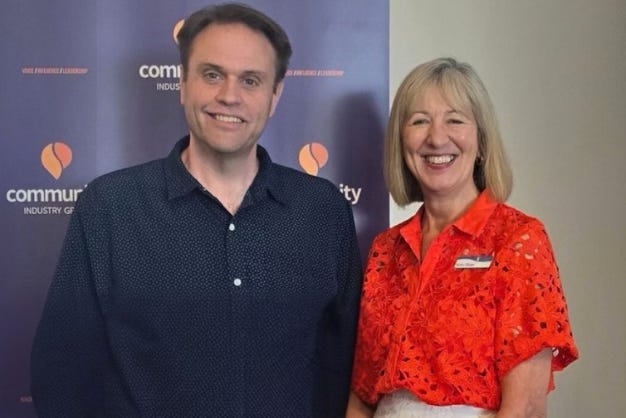
This was the sobering message delivered by Matt Grudnoff, a senior economist at the Australia Institute, during his recent keynote presentation for the Fairer Australia Social Justice Workshop.
Organised by the Illawarra-based Community Industry Group to celebrate World Social Justice Day, the event challenged regional thought leaders, professionals, and academics to critically evaluate how our nation generates and distributes wealth.
In his presentation, which you can relive below in the Community Industry Group’s Community Matters podcast, hosted by its CEO, Nicky Sloan.
Grudnoff highlighted a startling structural shift in wealth distribution over recent decades. Analysing the economic cycle between the Global Financial Crisis and 2019, he revealed a historic concentration of wealth.
“The top 10% over that period got 93% of the benefit,” leaving a mere 7% of economic growth for the remaining 90% of Australians. This immense disparity, Grudnoff explained, is driven by stagnant wages juxtaposed against surging corporate profits and investment yields.
The human cost of this structural imbalance becomes glaringly apparent when examining Australia’s most vulnerable demographics. Despite being the ninth-richest country in the OECD, Australia suffers from the fifth-highest poverty rate for citizens over 65.
Grudnoff highlighted the inadequacy of Australia’s age pension replacement rate - a metric comparing the pension to average wages - which currently sits at the second lowest in the developed world.
The financial safety net is even more frayed for those out of work. Grudnoff pointed to the nation’s unemployment assistance replacement rate, which measures how effectively benefits replace a lost wage. Out of all OECD nations, Australia ranks dead last, offering the least generous unemployment support in the developed world. This creates a paradox where profound systemic poverty persists despite vast national wealth.
The core of the issue is an insufficient revenue framework. “Australia is a low tax country,” Grudnoff stated, clarifying that while low- and middle-income earners pay average OECD rates, high-income earners frequently minimise their contributions.
“If Australia simply matched the OECD average for its tax-to-GDP ratio, the government would generate an astonishing $130 billion in additional annual revenue. What good could you do with $130 billion?” he challenged the audience.
Offering constructive solutions, Grudnoff proposed targeted reforms capable of raising $110 billion annually. Chief among these is a 25% tax on gas exports, projected to raise $17 billion. He contrasted Australia’s approach with Qatar; both export similar volumes of gas, yet Qatar secures “eight times as much revenue”.
Additional proposals include scaling back superannuation tax concessions - noting some accounts hold half a billion dollars, which he described as “dodging tax” rather than saving for retirement - and implementing a 2% wealth tax on assets over $5 million.
For the Illawarra’s social sector, understanding macroeconomic tax policy is vital. Grudnoff ultimately urged professionals to reframe their relationship with national economic metrics.
“The economy sometimes feels like one of those good old-fashioned gods that you need to sacrifice to in order to get a good harvest,” he warned. “The economy doesn’t exist for us to serve it, the economy exists to serve us.”