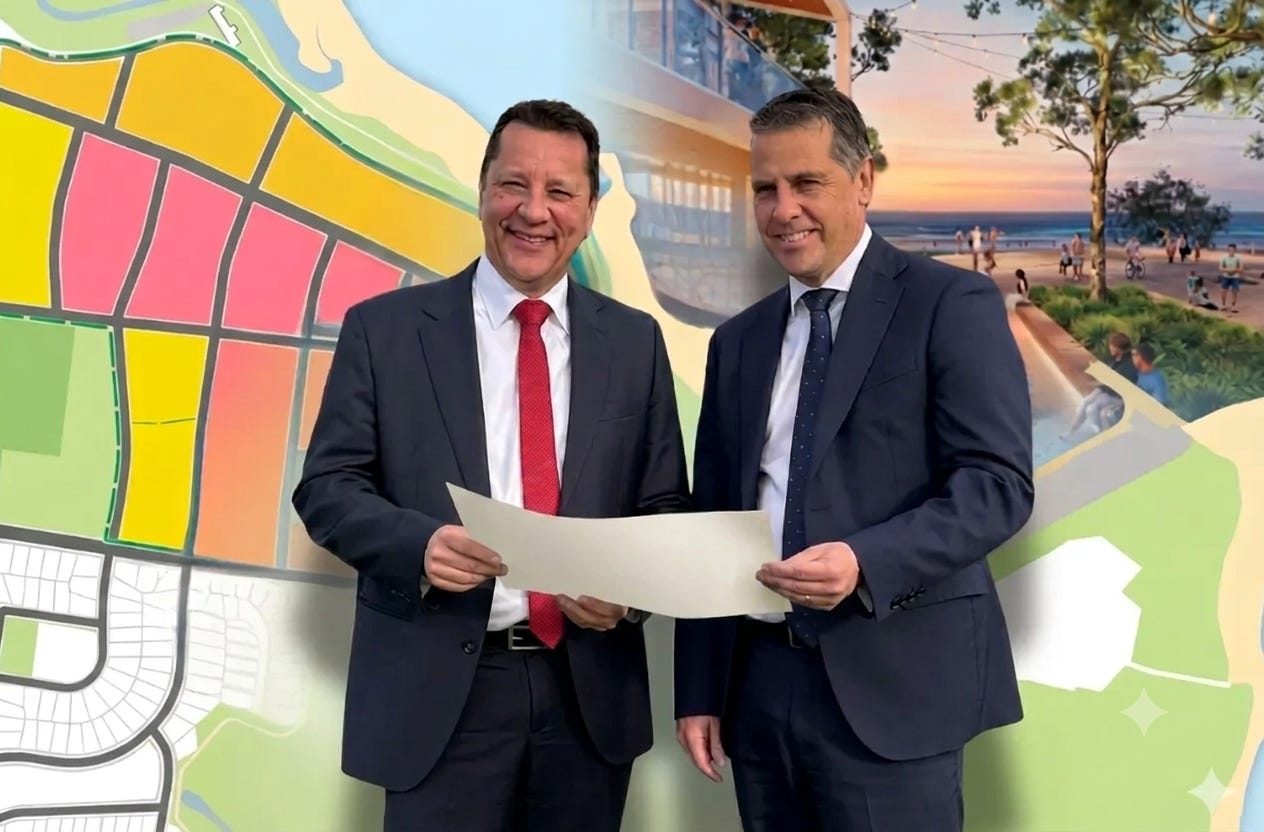
Bellambi Estate rezoned: Navigating supply, density, and dissent
Next steps for Homes NSW and Council

The NSW Government has finalised the rezoning of the Bellambi estate, paving the way for a multi-million-dollar redevelopment that is expected to deliver hundreds of new homes.
The project will proceed despite strong community opposition, with almost two-thirds of public submissions rejecting the proposal.
Of the 275 public submissions about the project, 168 (61%) were objections, 76 (28%) were supportive, and 31 offered general comment.
Scale, density, and urban transition
The sheer scale of the planned redevelopment explains the friction behind those numbers. The subject site currently contains 465 dwellings spread across 171 lots. Homes NSW owns 138 of these lots, while the remaining footprint comprises 24 privatel- owned parcels, seven held by the Aboriginal Housing Office, and two owned by Wollongong City Council.
The state government’s commitment to deliver at least 750 social homes - a minimum of 30% of the total - means the project will nearly double the estate’s current social housing footprint. This expansion targets a severe regional deficit; the Wollongong LGA social housing waitlist stands at approximately 2300 applicants.
However, density, bulk, and scale emerged as the primary flashpoints for the community. Objectors argued that introducing buildings up to six storeys high could increase the local population four- to five-fold, changing Bellambi’s low-rise coastal character while triggering visual impacts as well as noise and overshadowing concerns.
In response, the Department of Planning, Housing and Infrastructure noted that higher-density forms will be concentrated toward the centre of the site. Lower-scale developments will line the boundaries to transition smoothly into the surrounding neighbourhood - a strategy aligning with the mid-rise housing reforms applied to nearby Fairy Meadow and Corrimal. Detailed amenity impacts, including overshadowing, will be assessed at the development application stage.
“Renewing the Bellambi estate will create thousands of new homes close to the beach, open space, and public transport along with thousands of jobs for tradespeople needed to deliver this multi-year build,” Minister for Planning and Public Spaces and Member for Wollongong Paul Scully said.
“This is an overdue investment that will replace homes more than 50 years old with new, modern, high-quality housing. This is the largest investment in Bellambi ever.”
Infrastructure and utility constraints
Traffic generated the highest volume of specific complaints, with residents raising concerns over the ultimate capacity of Memorial Drive, Rothery Street, and local foreshore roads. While the state pointed to its Transport Management and Accessibility Plan (TMAP) as a resolution framework, infrastructure funding gaps remain unaddressed.
Transport for NSW (TfNSW) openly questioned the proposal’s initial “mode share targets” and requested revisions. Though Homes NSW subsequently prepared a TMAP addendum, TfNSW has advised it currently holds no funded projects to investigate or upgrade the Memorial Drive corridor, leaving long-term capacity questions open.
Utilities and environmental factors present additional hurdles. Sydney Water confirmed that wastewater servicing should be viable but indicated that further studies are required to establish a sustainable potable water strategy. Potential odour risks from the nearby treatment facility and pumping station was also flagged.
The Department of Climate Change, Energy, the Environment and Water stated the proposal fails to align with the NSW Coastal Design Guidelines 2023. It recommended ongoing consultation with Wolloongong council to manage adjacent foreshore hazards projected out to 2100. Homes NSW has committed to addressing both water designs and coastal hazards at the detailed design stage.
Governance, advocacy, and tenant impact
Existing residents expressed acute anxieties: from displacement to disrupted schooling, as well as the fracturing of community ties. The Department noted that timelines and relocations would be managed directly by Homes NSW.
Local government has sought to extract stronger policy concessions from the state. At its March 23, 2026 meeting, Wollongong City Council resolved to support the proposal in principle but strongly urged a higher social housing allocation and a minimum 10% affordable housing mandate - a mechanism omitted from the finalised state controls. The Council also requested that land marked for the expansion of Chounding Park be dedicated to local government free of cost, alongside funded commitments from Homes NSW for community, recreational, and open space infrastructure to match incoming population growth.
What’s next
Because the Department made no structural changes to the planning controls following exhibition, unresolved disputes regarding bulk, traffic, and biodiversity have effectively been deferred to future planning layers.
The timeline now shifts to individual development applications lodged by Homes NSW, which will be assessed under the amended Wollongong LEP 2009.
Previous reporting
It’s EOFY, which means everyone’s asking you to spend money. We’re no different.
But we’re asking you to back quality local journalism.