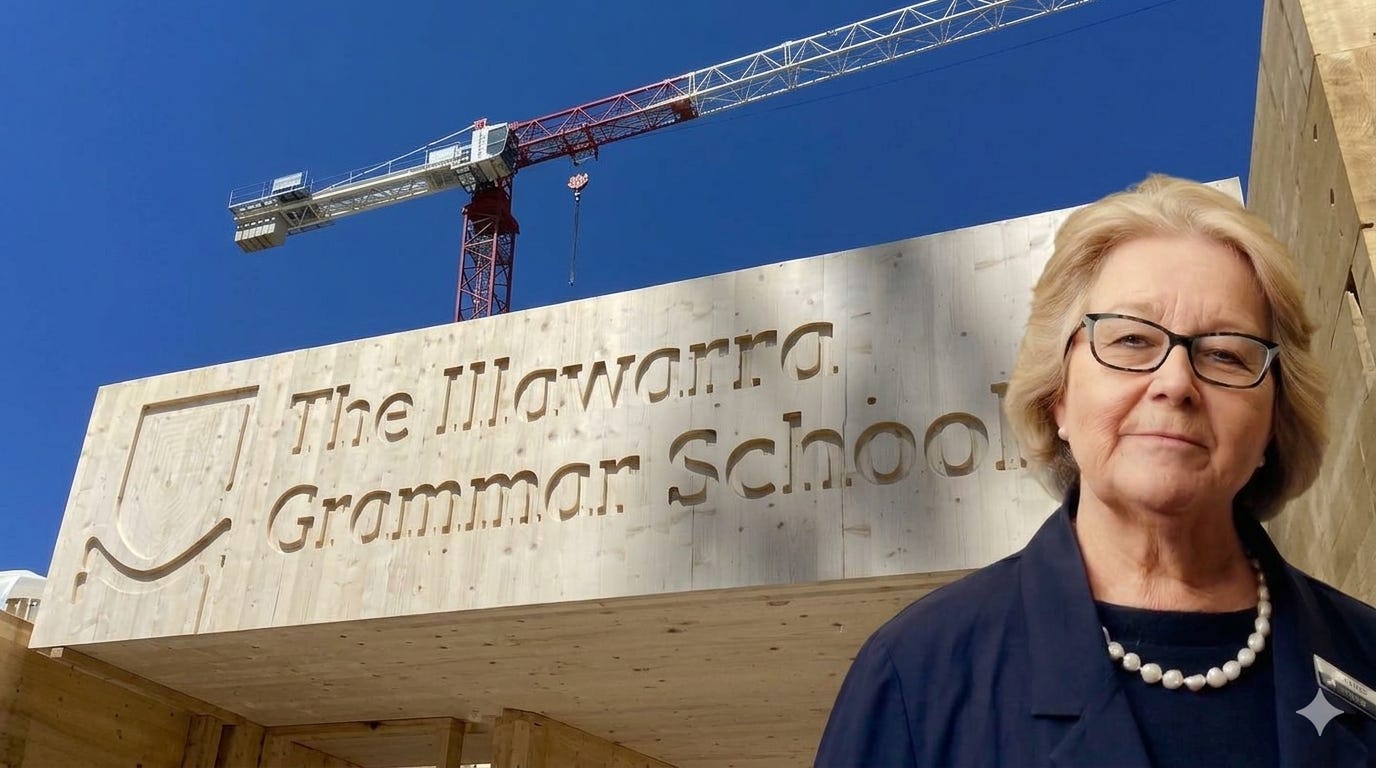
Blueprint from a bottom drawer: TIGS' $17m building is like no other
Coledale architects deliver NSW Passivhaus first

Dr Julie Greenhalgh has a term for the spaces she has spent her career trying to avoid. “In education speak, we call them cafe gymatoriums,” she says. “These are spaces that are meant to do everything. I don’t believe they end up doing anything well.”
When she arrived at The Illawarra Grammar School as principal in 2024, it became apparent the school was short on the specialist facilities she prizes: dedicated rooms with a single clear purpose, designed to do one thing properly. She raised it with the property manager. He knew exactly what to do. There were plans, he told her, sitting in a bottom drawer, shelved for reasons that may or may not have included Covid.
What the school did with those plans - reshaping them, financing them, and handing them to a Coledale architecture practice with a reputation for pushing sustainable construction to its limits - has produced a $17 million building that architects from around the country are now travelling to inspect, and a landmark that is quietly reshaping what educational construction in NSW can look like.
Scheduled for use by teachers and students early May, with an official opening event set down for Friday, May 15, the Hoskins Building’s design was the work of Betti & Knut, a sustainable architecture and interior design practice based in Coledale. According to the practice’s project page, the building will be the first school in NSW certified to the International Passivhaus Standard, featuring a mass timber structure, timber cladding with triple-glazed windows, a green roof and ample solar PV - carbon positive, storing more carbon and producing more energy than required for its standalone function.
The building is projected to consume approximately 90% less energy for heating and cooling, and its mass timber structure and façade store around 1200 tonnes of CO₂. A 150-seat lecture theatre - the school’s first - is on the upper level.
“When you walk into it, you notice different things,” Dr Greenhalgh says. “I clearly am the first to notice the smell of the timber. But one colleague says, ‘oh, listen how dampened the sound is’. The timber really absorbs the sound. And then another said, ‘just look at that beautiful grain in the timber’. Somebody notices the smell, somebody notices the sound, somebody the sight. It really is a beautiful, beautiful building.”
Working with the property manager on the existing plans, the school reshaped what had been conceived as a classroom block into something more considered. Because TIGS occupies a hill, the building bridges the two campuses naturally: the ground floor segues with the Junior School, the first floor connects to the Senior School.
Dedicated STEM lab included
The result is a building with a clear spatial logic. The ground floor includes five junior learning spaces, including a dedicated STEM lab and withdrawal spaces, plus extensive outdoor learning areas. A new Junior School library anchors one corner. Year 6 students occupy the remaining classrooms, positioned at the meeting point of the two schools: “they really are transitioning to the senior school very nicely,” Greenhalgh says.
The upper floor houses six senior classrooms, general learning areas and a flexible central space. The English department will anchor this level, one expression of a broader organisational principle the school is committing to. The lecture theatre, seating up to 150, is available to the whole school.
Three principles drove the decision to commit, Greenhalgh says: the move toward departmental precincts that cluster teachers and resources by subject; the need for specialist spaces the school simply didn’t have; and, most plainly, growth. “The school’s growing, and we just needed more classrooms.”
“We are getting more and more families move into this school from Sydney. They want a high quality education in a traditional grammar school, but they can’t afford to live in Sydney … and so Wollongong, and coming to this school, is just ticking that box for an increasing number of families.”
Current enrolment stands at 1100. The Year 7 cohort this year is the largest in the school’s history, and next year’s is already projected to be bigger again.
The construction method chosen remains rare in Australian institutional building. Cross-laminated timber (CLT) consists of layers of structural timber bonded in alternating directions under high pressure, creating panels of exceptional strength and fire resistance. The TIGS timber was sourced from Austria and manufactured to precision off-site.
“The frame, the structure went up in about four weeks,” Greenhalgh says. “The pieces just all fitted together. The power sockets were already cut out. The detail in the plans was just next level.” The school engaged local businesses and local architects wherever possible: “We’re absolutely committed to helping businesses here in this area,” Greenhalgh says. “We want everybody to benefit.”
Australia’s first Passivhaus building was completed in 2014, and while early uptake was slow, the standard is now being applied across commercial, education, hospitality and large-scale residential sectors. The Hoskins Building’s NSW-first certification places TIGS and Betti & Knut at the leading edge of that momentum in the state.
Being an education leader
The Australian and New Zealand CLT market was valued at USD$148.5 million in 2025 and is forecast to reach USD$621 million by 2034 as government policy and developer interest build behind low-carbon construction. TIGS is getting there ahead of the curve.
Speaking just before Easter, Greenhalgh was candid about the $17 million price tag: the school is in a position to manage it, and it was the right call. “We want to be leading the way in education in all of its aspects,” she said, “and providing appropriate facilities is one way to show that.”
The building’s name honours a valuable slice of local history. Arthur Sidney Hoskins and Helen Madoline Hoskins donated land for the establishment of the Wollongong Botanic Gardens. Their former family home, Glennifer Brae, was the site of SCEGGS, the girls’ school which merged with The Illawarra Grammar School in 1976.
There is already a next project on the whiteboard. Sports facilities, Greenhalgh says, though that is “down the track.” The phrase that has come to define the school’s last year, she jokes, is the one that replaced the pandemic-inspired “you’re on mute”: “When Hoskins is finished.” That might be due for a change soon.