Corrimal among first suburbs to adopt NSW’s fast-track housing designs
Pattern-book designs arrive in Illawarra.

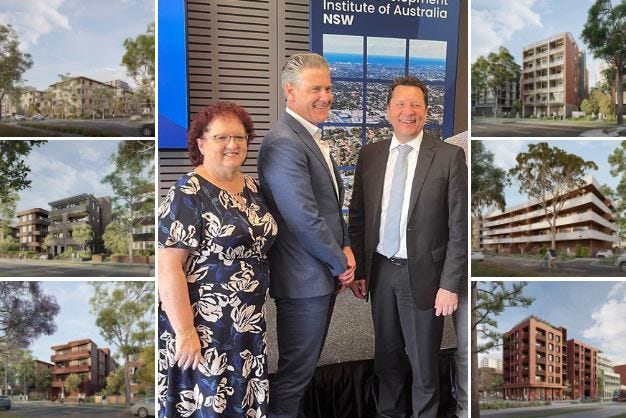
Corrimal has become an early test case for NSW’s pattern-book housing reforms, with Minister for Planning and Public Spaces, Paul Scully, revealing one of the state’s first low-rise applications has been lodged in the suburb.
Speaking at the UDIA Illawarra Christmas Luncheon on Friday, December 5, the Member for Wollongong also disclosed that the first mid-rise pattern-book site was sold in Blacktown within the previous 24 hours.
It’s the first commercial transaction involving the newly released apartment designs. “I’m pleased to be able to report today that last night the first one of those patterns was sold for a block in Blacktown,” he said.
He confirmed a “Row Homes” design had been lodged in Corrimal. The design has four homes arranged side-by-side but when viewed from the street they appear like a detached house. The plan can currently be bought for $1 on the NSW Planning website.
The announcements follow the public release last month of nine architect-designed pre-approved mid-rise patterns covering three to six storeys.
Under the pattern-book model, each design has already been tested for feasibility, compliance and constructability.
Councils have been instructed to halve assessment times for mid-rise developments built to the approved templates. Currently, Wollongong City Council’s average DA assessment time is 81 days.
“The reality is we’ve been sweating the small stuff,” Scully said.
“Ninety per cent of DAs that come into the New South Wales planning system, whether at a council level or on a state level, are for a million dollars or less. Ninety per cent. We are spending an extraordinary amount of time on relatively low-risk things, which means we’re not spending the right amount of time on those bigger, more significant projects.”
The new mid-rise patterns include options for small lots, large lots and corner lots, with a subsidised introductory price of $1,500 for small-lot and corner-lot designs and $2,500 for large-lot designs - roughly one per cent of the cost of commissioning bespoke architectural work.
The designs prioritise cross-ventilation, solar access, energy efficiency and full compliance with the national Liveable Housing Design Standard.
“They’re designed to be sustainable, livable, accessible,” Scully said. “That’s allowed us to examine key things like waste and accessibility and the Apartment Design Guide - and then we can take that out of the assessment.”
Scully said statewide housing approvals were up 26 per cent and commencements up 27 per cent, with 48 rezonings in the pipeline with the potential to deliver 200,000 homes.
He also used the luncheon to highlight the growing importance of modular and factory-based construction, describing it as essential for both productivity and resilience as weather extremes increase.
Speaking at the Captains Lounge at WIN Stadium on Wollongong’s hottest December day in two years, he said:
“I don’t think anyone in this room would want to be on a building site today,” he said, noting that heat days are becoming as disruptive as rain days and will intensify over the next 10 to 30 years.”
Modular construction, he argued, allows projects to continue uninterrupted in controlled environments and reduces the risk of costly delays.
He framed modular as a workforce solution.
By shifting more activity into a predictable factory-based setting, the sector can attract workers who are currently underrepresented across building trades.
“We can open up the whole construction sector to that other 51% of the population who tend not to be involved … which is women,” he said, pointing to better facilities, consistent hours and safer conditions as major advantages over traditional sites.
Four other things Scully said that matter for the Illawarra
Wollongong has lodged more than 1,800 housing approvals since July, making it one of the top-performing councils in the state.
Three State Significant Development proposals for the Illawarra — totalling around 650 homes — are currently under assessment.
The Wollongong Health Precinct master plan is close to finalisation, pending final input from Transport for NSW.
Population growth in the Illawarra–Shoalhaven is forecast at 1.6% per year, outpacing the NSW average of 1.1%.