Could a PhD researcher solve your real business problem right now?
Well, yes, says Sample Assist founder Heath Cooper
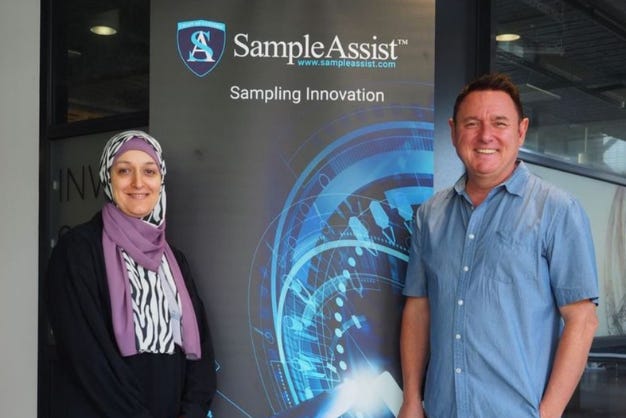
When Asmaa Seyam began her PhD at the University of Wollongong, her research focused on machine learning systems to reduce food waste and strengthen supply chain resilience. Her internship took her somewhere different entirely: a Wollongong medical technology startup trying to overhaul the way pre-employment health assessments are managed.
The disciplinary leap was deliberate. Sample Assist founder Heath Cooper was building a platform to streamline a process he described as complicated, expensive and involving too many disconnected parties - employees, employers, clinics, laboratories and healthcare professionals. Seyam’s task was to map each medical test required in the pre-employment process, build detailed workflow profiles, and identify where the system could be made to run faster and with less friction.
“Although the disciplinary focus differed, the internship project required many of the same competencies developed during my PhD,” Seyam said, citing data-driven analysis, identifying process inefficiencies, and translating complex findings into practical recommendations.
A win-win scenario
“Through the internship, I worked on optimising the pre-employment medical assessment process, allowing me to see firsthand how analytical and research techniques can be used to address real business challenges,” she said.
“The experience strengthened my ability to bridge theory and practice by adapting academic knowledge to industry needs, collaborating with stakeholders, and delivering outcomes with practical impact.”
For Cooper, the value was direct: access to research-grade analytical capability without the overhead of a senior hire.
The placement was part of UOW’s expanded Applied Research Placement program, now open to PhD candidates across all disciplines following a pilot funded through the federal government’s Women in STEM and Entrepreneurship initiative.
Georgia Watson, who coordinates the program through UOW’s iAccelerate hub, said demand from both sides had driven the expansion.
“We had businesses approaching us - people we couldn’t help because they fell outside the grant parameters,” Watson said. “That told us the appetite was real.”
The program targets early-stage PhD candidates, typically post-first year, and pairs them with businesses carrying a genuine research problem. For eligible host organisations, the three-month placement carries no cost. UOW funds the intern’s stipend and keeps the PhD supervisor actively involved throughout.
Watson said the program was particularly interested in expanding beyond STEM into humanities, social sciences and the creative industries — areas where industry placements are less common but the analytical toolkit of a PhD candidate can be applied in unexpected ways.
‘Meaningful connections’
Seyam’s internship ran for three months, full-time and paid, alongside her continuing candidature. She said the experience shifted her understanding of where her skills could travel. Her professional relationship with Sample Assist has continued, and Seyam believes a stronger focus on maintaining connections after placements finish would make the program even more valuable.
She would happily recommend the ARP Intern program to fellow students: “It not only helped me develop practical and professional skills, but also allowed me to form meaningful connections with expert professionals.”
It’s that time of the year: EOFY sale time.
Yes, you can save money with us, too. RIGHT HERE