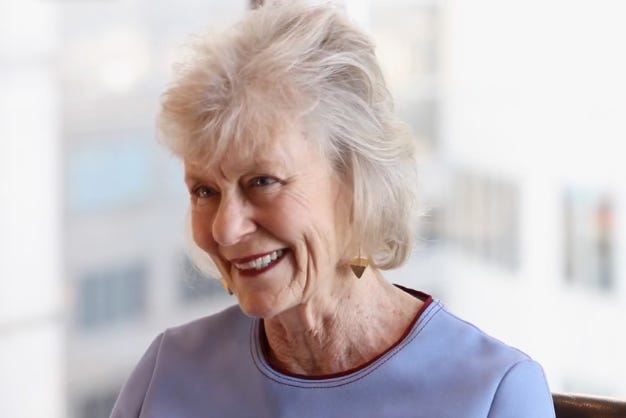
Ex-UOW Chancellor says capping international students isn't the answer
The funding flaw no politician wants to address

A former University of Wollongong chancellor has taken aim at the political debate around international student caps, warning it obscures a deeper and more damaging failure: the federal government’s chronic underfunding of university research.
Jillian Broadbent, economist, former Reserve Bank board member, and UOW’s Chancellor for 11 years, didn’t mince her words in a new episode of the Success and More Interesting Stuff podcast, hosted by Matthew Kidman.
“The flaw in the whole tertiary education model in Australia is that the government doesn’t fund research enough,” Broadbent said. “It never gets going very much from inflow from the federal government.”
Broadbent argued that international students are not the problem — they are the solution universities have been forced to find on their own. With HECS covering only around half the cost of educating a domestic student, universities rely on full-fee-paying international students to cross-subsidise research and attract academics of the calibre needed to maintain institutional quality: “The only way they can fund research and attract academics of a certain calibre … is having foreign students,” she said.
That structural dependency, she argued, is now being punished. When COVID closed borders and, more recently, when immigration politics prompted calls to cap international enrolments, universities faced the double bind of losing revenue without any compensating increase in government research funding.
“You can’t just cap the university research programs,” she said. “To discontinue them … they’re important to the wellbeing of the country.”
For the Illawarra, the stakes are tangible. UOW’s internationally recognised clean energy research - including the Solar Decathlon-winning Illawarra Flame project, which Broadbent has described as among the proudest moments of her chancellorship - depends on exactly the funding model she is defending. It was that same research culture she championed as UOW chancellor that ran in parallel with her role as inaugural chair of the Clean Energy Finance Corporation, where she helped mobilise nearly $2.1 billion in green investment in a single financial year.
Broadbent reserved particular frustration for the political shorthand that has eroded public trust in universities. “Politics comes down to throwaway lines,” she said, “and then the general public says the universities are overstaffed, don’t teach very well, and their standards have dropped. Those comments get picked up by politicians and picked up by the general public — and so they lose some of the respect for the real quality of both teaching and research undertaken at the university level.”
How COVID hit the bottom line
Official UOW statistics show the university had 8745 international students onshore in 2019, generating $308 million in international student fees.
COVID-19 border closures drove that onshore figure down to 5468 by 2022 - a 37 per cent drop - with international fee revenue dropping to $199 million.
By 2023, onshore enrolments had recovered to 8235, with fee revenue rising to $259 million. These figures are drawn from UOW’s annual In Numbers publications.
However, UOW recorded operating losses of $28 million in 2022 and $95 million in 2023, according to financial statements contained in the same reports, suggesting the structural funding pressures Broadbent identifies have persisted even as student numbers have rebounded.
Read more on Success & More Interesting Stuff here
Ditch the noise. Find the signal.
The Pulse Illawarra delivers high-yield intelligence for the Illawarra’s business and academic leaders. Read about the people, projects and policies shaping the region’s next decade.


