Five key takeaways from two NSW Government plans shaping the Illawarra
We've done the heavy lifting for you.

Two newly released NSW Government documents are set to reshape the Illawarra’s economic trajectory, providing the clearest roadmap yet for how the region will support the state’s next generation of industry, freight and energy.
The Draft Illawarra–Shoalhaven Integrated Transport Plan and the Draft Statewide Policy for Industrial Lands were released within days of each other - and together, they deliver a strong signal that the Illawarra is being positioned as a state-significant engine for future jobs and investment.
We’ve pulled out the key talking points from each document so you don’t have to.
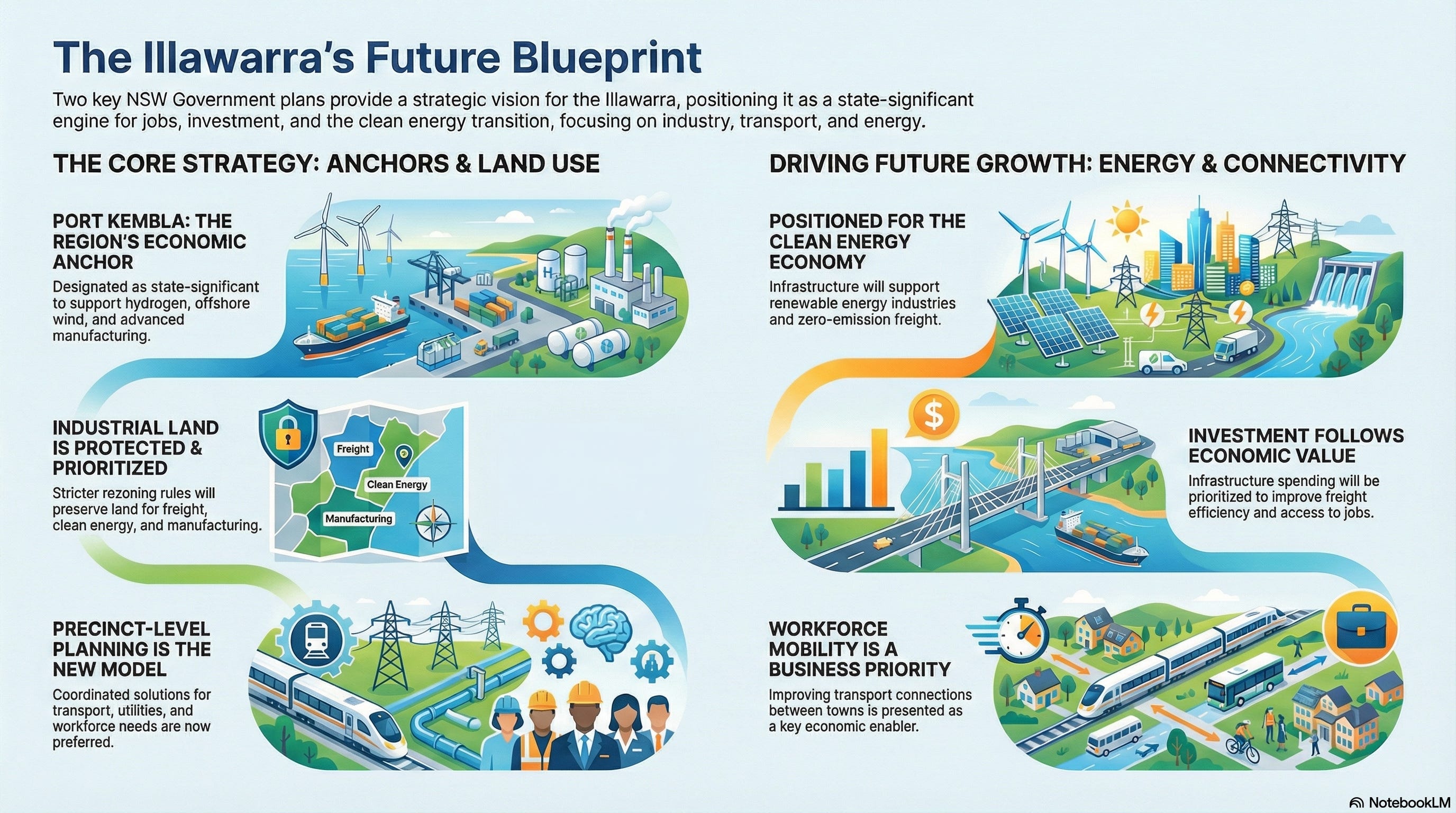
Port Kembla at the centre of the vision
Across both documents, Port Kembla emerges as the anchor of the region’s economic future.
The transport plan commits to strengthening freight corridors, improving safety and reliability, and preparing the network for the Port’s growing role in energy, manufacturing and container trade.
The industrial lands policy designates the precinct as state-significant, signalling long-term protection and prioritised investment for land supporting emerging industries such as hydrogen, offshore wind and advanced manufacturing.
Since the documents were released, the rezoning of BlueScope’s 200 hectares of non-operational land was officially announced.
Transport priorities will follow economic outcomes
Both documents emphasise that infrastructure investment will flow where it best lifts productivity.
The transport plan says investment will be prioritised to “improve freight efficiency and enhance access to employment and education.”
It notes that the Maldon-Dombarton line is a key component for success.
The industrial lands policy focuses on productivity benefits for NSW.
It’s clear that, for businesses, advocacy will be strongest when transport needs are directly linked to economic value.
Industrial land will be protected - and used strategically
The industrial lands policy introduces a firmer, more interventionist approach to preserving industrial areas across NSW. It states that industrial land is increasingly scarce in Greater Sydney and highlights the strategic significance of the Illawarra’s supply.
“Regions with existing industrial capacity, port access and strong transport connectivity will play a critical role in meeting the state’s future industrial land needs,” the policy says.
Industrial lands policy changes
Rezoning industrial land will be subject to stricter restrictions.
Land critical to freight, clean energy and manufacturing will be protected.
Planning will increasingly occur at the precinct level rather than site by site.
Precinct planning is the new normal
From Port Kembla to West Dapto, South Nowra to Shellharbour, precinct-level planning is now the preferred model across both documents, with coordinated solutions encouraged.
The transport plan says investment decisions should consider how transport networks support regional centres, while the industrial lands report focuses on how industrial precincts should be “integrated systems, including transport access, utilities, land supply and workforce needs.”
Region positioned for the clean energy economy
Both the Draft Illawarra–Shoalhaven Integrated Transport Plan and the Draft Statewide Policy for Industrial Lands explicitly position the Illawarra as central to NSW’s clean energy transition.
The transport plan identifies the need for infrastructure to support a low-carbon economy, zero-emission freight, and emerging energy industries. It highlights Port Kembla’s role in enabling renewable energy and energy export opportunities.
At the same time, the industrial lands policy confirms that land supporting the energy transition, including renewable energy, advanced manufacturing and related supply chains, is of strategic importance to the state, with port-based and regionally located industrial precincts expected to play a critical role in delivering new clean energy industries.
Workforce mobility is a business issue
The transport plan draws a clear link between mobility and productivity. Safe, reliable connections between Wollongong, Shellharbour, Kiama and Shoalhaven are presented as economic enablers.
The plan prioritises improving the reliability and frequency of public transport, strengthening connections to major employment and industrial precincts, and fixing first and last-mile gaps that make public transport impractical for many workers.
It also focuses on reducing travel time variability through congestion management and safety upgrades on key commuter routes, while recognising the need to support shift work and non-standard hours.
The industrial lands policy reinforces the link between connectivity and productivity by emphasising that industrial land must be supported by efficient transport access and workforce connectivity.
It makes clear that industrial precincts depend on reliable road, rail and freight connections to function effectively, and that access to labour catchments is a key determinant of productivity and long-term viability.
The Draft Illawarra–Shoalhaven Strategic Regional Integrated Transport Plan is open for feedback until Monday, February 9.
The Draft Statewide Policy for Industrial Lands is open for submissions until February 27.