


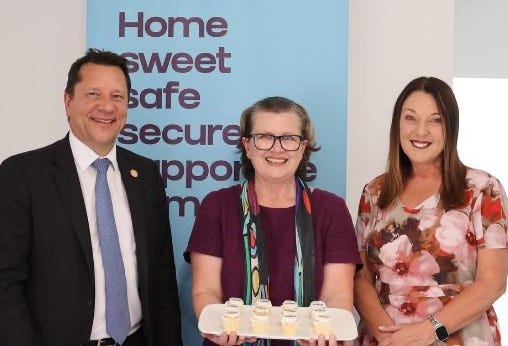
A long-standing domestic violence service in the Illawarra is overhauling how it operates, shifting to a regulated housing provider model as demand in the sector grows.
Over the past two years, SASSI has restructured its systems, governance, and service delivery to operate as a Tier 2 community housing provider, positioning the organisation to deliver and manage a larger housing pipeline.
The change, which includes a name change from Supported Accommodation & Homelessness Services Shoalhaven Illawarra to SASSI, has been led by CEO Penny Dordoy and marks a shift away from a traditional refuge model toward a more structured, scalable approach to housing and support.
Dordoy said the shift has come from taking a closer look at where the organisation makes the biggest difference.
“We’ve been really focusing on what we do well in this sector and carving out our space,” she said.
“When people come to us, it’s because they need a roof over their head and support to gain housing independence. We’ve been creating new pathways to housing and making it simple for people to access support.”
For decades, crisis accommodation has often meant shared housing. Dordoy said that model no longer meets the needs of women and children leaving violence.
“Women should be able to flee violence into something that feels safe, affordable, and the right place for them to recover,” she said.
SASSI is now delivering self-contained units rather than shared spaces, allowing families to recover in their own environment while still accessing support.
The model brings services to clients, like counselling or financial support, before gradually reconnecting them with external providers as they prepare to move on.
Becoming a Tier 2 community housing provider has enabled that approach, allowing SASSI to access more housing opportunities while operating under stronger governance and regulatory requirements.
“It allows us to be more ambitious, but also more closely checked against those ambitions,” Dordoy said.
That ambition is already showing in the pipeline. The recent opening of Wilga, six refurbished crisis dwellings in the Illawarra, backed by more than $4.6 million in federal funding, forms part of a broader rollout that will see 29 new homes delivered across the region this year.
It reflects the pace at which SASSI is expanding its housing footprint in response to sustained demand. At any given time, around 170 people remain on the organisation’s waitlist across the Illawarra and Shoalhaven.
Growth has not just been about adding housing stock. Internally, SASSI has invested in systems, staffing and new ways of working to support that expansion.
This includes partnerships with organisations such as Toyota’s philanthropic arm to review operational processes, as well as internal initiatives like a monthly “innovation hour”, where staff develop and pitch new ideas to improve services.
Some of those ideas are already in place, including an art-based recovery program for women and an on-country initiative supporting Aboriginal clients.
Alongside housing delivery, SASSI is also investing more in early intervention, working with clients to sustain existing tenancies where possible and reduce the flow into crisis services.
For Dordoy, the longer-term goal is to ease pressure on the system by keeping people housed in the first place.
“If we can keep people in their houses before they become homeless, then it saves everybody a lot of heartache, a lot of money, and really just takes pressure off the entire system,” she said.