


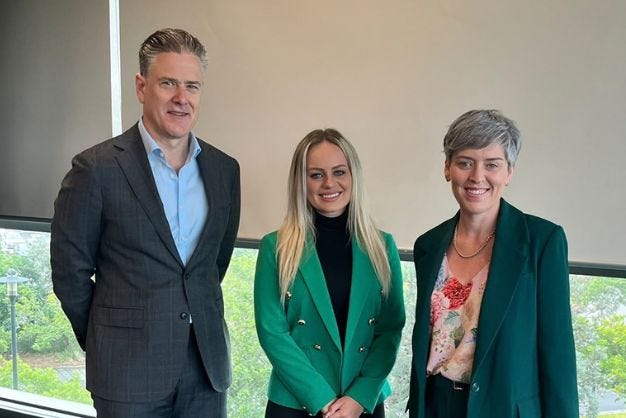
A $65 billion economy spanning eight council areas is strengthening the Greater Illawarra’s case for investment alongside regions such as the Hunter, business leaders heard on Wednesday.
Business Illawarra director Coralie McCarthy told Colliers’ Wollongong Investment Briefing that the combined area, stretching from the South Coast through the Southern Highlands to Macarthur, supports more than 300,000 jobs and 63,000 businesses.
“When you start bringing us together as LGAs, the Greater Illawarra is worth listening to in a big heavyweight sense,” she said. “Sure, Newcastle’s big, but so are we.”
McCarthy said the region’s strengths in manufacturing and construction gave it a base to build on, while professional, financial and technology services offered room for growth. Its position between Sydney, Western Sydney and Canberra was another advantage for businesses looking to invest.
The challenge was helping its many small businesses become larger employers and ensuring they had the employment land to expand. “How do we take our vast number of small businesses and help them to grow and become big businesses?” she asked.
The eight councils have formed LG8, a strategic partnership launched at NSW Parliament House and led by Wollongong Lord Mayor Tania Brown.
Colliers managing director Simon Kersten said acting together could give the councils a stronger voice when competing with other regions for funding.
“This region’s always missed out on so many things over the years because we’ve never had the political voice to demand that,” he said. “But with a region as big as LG8, we might finally get somewhere.”
Colliers’ property data offered a closer look at where investors are putting their money.
Associate director of investment services Taleah Thomas said approximately $3.2 billion in commercial property had been sold across Wollongong, Shellharbour and Kiama since 2020, with Wollongong accounting for about 84 per cent of the value.
Commercial transactions reached about $425 million in the first half of 2026. Investment sales accounted for $309 million across 16 deals, exceeding the $216 million recorded across 38 deals during the whole of 2025.
The $103 million sale of Corrimal Village accounted for roughly a third of this year’s investment sales value. MA Financial sold the centre to an undisclosed buyer in February; Colliers described it as the largest non-metro neighbourhood centre sale nationally since 2021.
Thomas said the first-half result showed substantial capital was available, but buyers were selective.
“Buyers are looking for good quality assets with strong income, long leases, and the right fundamentals,” she said.
They were also weighing tenant reliability, how easily they could be replaced when a lease ended, and what a building might cost to maintain.
Thomas cautioned that a few major deals could lift the headline total without signalling stronger activity across the market. Shopping centres generated substantial value through just three transactions in the latest 12-month period Colliers examined, while industrial property recorded 19 deals.
“Shopping centres are driving our headline value, while industrial is probably giving us a better depth in the actual market,” she said.
That made the number of deals in the second half of 2026 as important as their combined value. “I’ll be interested in not only the final dollar value, but how many transactions actually make up that number,” Thomas said.