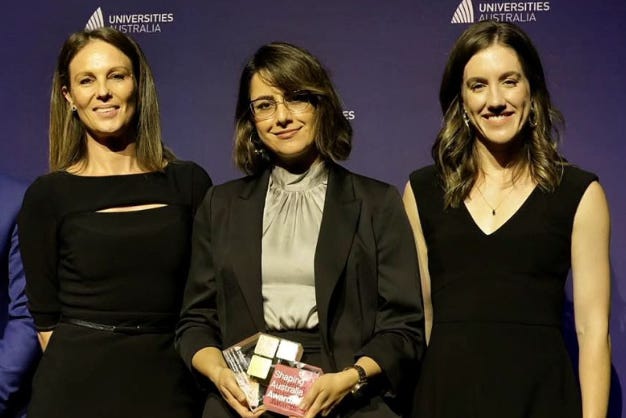
Ground-breaking UOW cancer implant research wins Shaping Australia Award
Targeted pancreatic tumour treatment wins national people's choice

A research team based at the University of Wollongong has won the Problem Solver People’s Choice Award at the 2025 Shaping Australia Awards.
The project, led by recently graduated PhD researcher Dr Elahe Minaei under Associate Professor Kara Vine-Perrow, centres on an implantable device that delivers chemotherapy and immunotherapy directly into pancreatic tumours - targeting treatment at the source rather than systemically, with the aim of reducing side effects while improving efficacy.
It received 6284 votes from a national pool of 42,500 cast across all categories.
Dr Minaei, who offered thanks to A/Prof Kara Vine-Perrow and Dr Samantha Wade, as well as her “ever supportive husband Dr Mohammad Makki”, also paid tribute to UOW’s executive.
She offered gratitude to “Vice-Chancellor Professor Max Lu, Prof Mark Hoffman, Professor Alan E. Rowan and to everyone who voted and supported this work. This is for patients, families, and the future of cancer care,” she wrote after the awards in Canberra on Wednesday night.
“In pancreatic cancer, the immune system often doesn’t recognise the tumour as a threat,” Dr Minaei said. “Our goal is to take this research from the lab into the clinic, where it can give patients more time, better quality of life and more hope.”
UOW Vice-Chancellor and President Professor GQ Max Lu said the team’s research sent a powerful message about the issues that truly matter to our communities.
“This pioneering work is science at its most meaningful, translating discovery into life-changing solutions and delivering impact where it is needed most,” Prof Lu said.
It’s not Dr Minaei’s first people’s choice award, having won it and being named the overall winner at 2024’s UOW Three-Minute Thesis competition. That same year she received the Dr Margaret Gardiner IWD Scholarship for Medical Research at the International Women's Day Illawarra Committee awards.
Why it matters
Pancreatic cancer carries a five-year survival rate below 13 per cent. Most patients are diagnosed at a late stage and face months, not years. The disease’s resistance to conventional treatment stems partly from the tumour’s ability to evade immune detection — a problem the UOW system attempts to address by delivering immunotherapy locally.
In preclinical mouse model trials, the implants slowed tumour growth, extended survival, and preserved gut microbiome diversity compared to standard systemic therapy. The team’s stated next step is clinical translation.
The award result positions UOW’s health innovation pipeline in public view at a time when the region is increasingly framing advanced medical research as an economic pillar alongside steel transition and renewables. The university has not announced commercial partnerships or clinical trial timelines.