


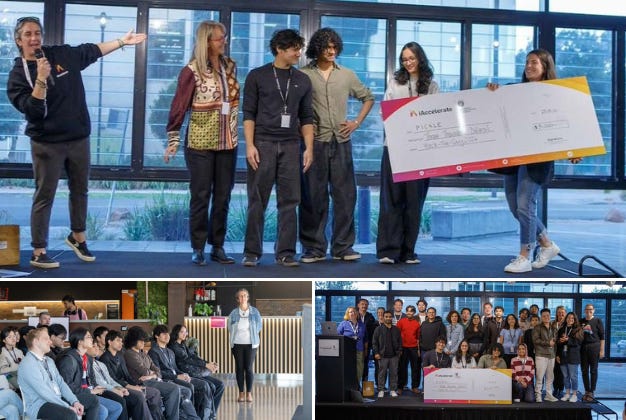
The best test of a hackathon is what happens after the judges deliver their verdict.
At iAccelerate on the University of Wollongong’s Innovation Campus, some of the teams behind this year’s Hack the Gong are doing their best to turn their ideas into opportunities.
The event returned in August after a two-year absence, bringing together more than 100 innovators to tackle real-world problems over 30 hours.
Last week, several teams were back at iAccelerate, this time meeting with Wollongong City Council representatives, industry stakeholders and others to talk about what they had built and whether there was scope to take the ideas further.
The follow-up was not part of the original hackathon program. It came about after participants and stakeholders expressed an interest in continuing the conversations, iAccelerate business development lead Rebecca Glover explained.
“We had quite a few students in the course of the time between the hackathon and now reaching out to me, saying, ‘Is there an opportunity to follow up?’
“Similarly, council in particular and a few other stakeholders have been reaching out pretty regularly saying, ‘I’d love to hear more about what was built and what came of it’. People are really engaged,” Glover said.
This year’s Hack the Gong was built around problems put forward with help from industry and civic organisations.
Wollongong City Council supported an Energy Fairness Challenge with a $3000 prize. Scalapay, the European buy-now-pay-later company co-founded by UOW alumnus Johnny Mitrevski, and Siligong Valley were also involved through mentoring, judging and other industry support.
Glover said the idea was to give participants problems they could encounter outside the university.
“We’re really trying to maximise the opportunity for people to grab hold of a real-world challenge and build something that can be taken and have a life beyond it.”
She said the event also gave organisations a chance to see what local technology talent could do: “If we can help people see what talent we have here, especially if it ties to a real industry problem, that really gives people like council some ideas,” she said.
“But the other side of it is creating connections for people in the tech community - that’s a really big part of it.”
Among the projects discussed at last week’s session were ideas involving energy sharing, electricity demand and waste management.
Team Pickle and CommVolt developed peer-to-peer energy concepts focused on incentives for solar generation and energy sharing, including possible applications in lower socio-economic communities.
Another project looked at using spatial data to model changes in local electricity demand and identify potential locations for community batteries.
Two teams, Toucan and The Gulf Face, worked on computer-vision approaches to waste sorting, using image recognition to identify waste and direct it towards the appropriate disposal stream.
The chance for refinement
The projects were built in 30 hours, so the teams still have plenty of work to do if they are to become working products or services. That was one reason for bringing the teams and stakeholders back together.
The event also gave students an opportunity to meet organisations working in the technology sector and discuss the problems they are trying to solve. Students were keen to get more exposure to industry, Glover said.
“For the students coming to participate, they’re developing skills that will be really useful in a changing workforce.”
AI was also part of the event, with novelty prizes recognising teams that demonstrated sound approaches to using it.
“Feedback that I got from the students particularly is that when they’re studying and AI is changing the workforce so much, they’re really, really grateful for opportunities like this because they don’t get a heap of industry networking opportunities where they can actually connect with people and understand what the problems really are,” she said.
Whether any of the projects go further will depend on what the teams and interested organisations do next.
iAccelerate is already looking at running Hack the Gong again next year, with interest already received from participants and industry about how the event could be expanded.
“It was that good melting pot of everything that iAccelerate is, and so I think yeah, we’re really keen to make it happen again next year … I’ve had conversations with industry about how we can improve on it again and have even more engagement.”


