


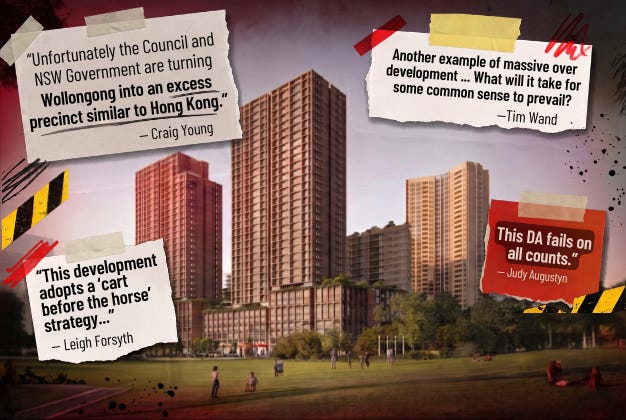
Wollongong knows it as “the old Bunnings site”, on the corner of Gipps and Flinders streets. It is now one of the biggest pieces in the jigsaw that is fast becoming the 21st-century Wollongong CBD skyline.
Developer Level 33 wants to turn it into a five-tower complex reaching 36 storeys, or 125 metres, into the CBD skyline. The proposal, designed with state housing mandates in mind, has State Significant Development status. But as the housing crisis continues to bite, the plans have drawn a sharp response.
Wollongong City Council has objected. So have the State Emergency Service and other agencies, while submitted community opposition has been overwhelming.
The public exhibition has closed and, of the 70 submissions lodged on the Department of Planning, Housing and Infrastructure website, just two support the proposal. Three offer comments. The other 65 object.
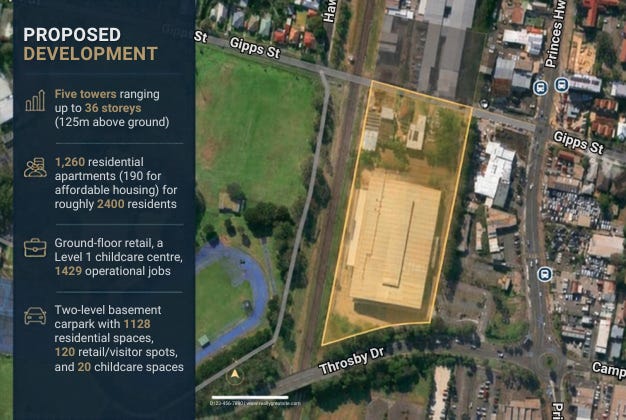
Level 33’s plans cover 1.34 hectares and would house about 2400 people in 1260 apartments, including 190 set aside for affordable housing.
The scale of the proposed change is substantial and flies in the face of council-developed planning framework adopted in May. The council’s Flinders Street Urban Design Framework, developed through extensive internal and community consultation, caps building heights north of Gipps Street at 32 metres. The limit is intended to protect Indigenous cultural sightlines and preserve open views towards Mt Keira.
Level 33’s proposed towers would rise far beyond that limit.
One supporter, writing from Chatswood, argued the project would “significantly improve housing affordability in the area”. But several local residents questioned whether the state’s affordable housing reforms would deliver the promised benefits.
“Here we go again … with developers milking the affordable housing scam with impunity,” one resident wrote.
Wollongong City Council’s objection was even stronger. Major development manager Pier Panozzo said the proposal “disregards safety, local impacts and council’s strategic planning investment” and fails to provide public benefits or infrastructure proportionate to the uplift sought.
Dorte Ekelund, a Wollongong resident and town planner with 40 years’ experience, agreed the site could accommodate more housing, but questioned the proposed scale:“This site is eminently suitable for urban intensification ... However, the proposed scale of this Development will significantly detract from the visual and community amenity in Wollongong - a city recognised as being nestled between the mountains and the sea.”
Aviation danger, flood risks
Objections extend well beyond building heights and views. The Civil Aviation Safety Authority (CASA) and the SES have both raised operational safety concerns.
CASA warned Tower 1 would rise about 70m above Wollongong Hospital’s helipad, just 1km away. It said the tower could pose a problem for helicopters coming in to land, particularly if they had to abort and climb away. It called for an immediate review by Airservices Australia to ensure emergency medical flights and construction cranes would not compromise aviation safety.
The site sits across the Fairy and Cabbage Tree creeks floodplain, and the SES warned that extreme rainfall could isolate the development’s middle towers for up to 45 minutes. It also identified conflicting information in the design documents about basement car park flood barriers. It wants all access ramps and ventilation shafts raised above the “probable maximum flood” level to address potentially catastrophic risks to life.
Traffic troubles
It forecast 865 vehicle trips during peak hours: 372 in the morning and 493 in the afternoon. Level 33 argued that was only marginally more than the traffic generated by the former Bunnings store.
Transport for NSW wasn’t buying it.
Bunnings has been closed for years, the authority pointed out, making it a poor measure of current traffic. It also flagged waits of more than 50 seconds for pedestrians crossing Flinders Street at Gipps Street, and noted that local bus operators had been left out of the assessment.
In its submission Dion’s Bus Service, which runs key routes along Flinders Street, said: “Dion’s has not been consulted by the applicant or its consultants at any stage... Our concerns are the safety of our passengers, our drivers, pedestrians and other road users and whether we can keep running a reliable service.”
Transport wants Level 33 to provide its original traffic-modelling files so the authority can check the calculations. It has also called for a revised assessment that accounts for traffic growth of 2% a year over the next decade.
How the site’s evolved
Level 33’s vision has had a number of iterations.
It began as a 900-apartment, 40-storey concept before moving to a 1500-unit EOI via the Housing Delivery Authority in September 2025 (including 260 affordable homes). A year later, with State Significant Development status the 1260 apartment plan was submitted to authorities. Though scaled back, it’s the region’s biggest residential proposal, adding about 2400 residents to Wollongong’s CBD fringe.
December deadline
The objections leave Level 33 facing questions about multiple aspects of its latest proposal.
Wollongong City Council has urged the department to require a “substantial redesign”. State agencies have called for further work on flight paths, flood safety and transport impacts.
Developer Level 33 now has to respond. Company director Charbel Kazzi has been asked to submit a comprehensive report addressing agency and community objections by December 7, 2026.