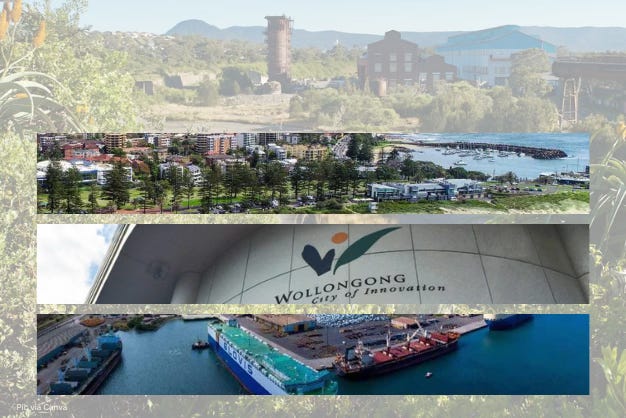
How Wollongong plans to deliver a whopping 20,500 new jobs by 2035
Port Kembla at the heart of city's economic strategy
Wollongong City Council has placed the rezoning of 200 hectares of surplus BlueScope land at Port Kembla at the centre of its long-term employment strategy, as it targets the creation of 20,500 net new jobs across the local government area by 2035.
The target forms the backbone of the council’s Economic Development Strategy 2025–2035, released on Monday as Wollongong seeks to shift its employment base beyond population-driven growth and traditional heavy industry. The strategy follows the completion of the city’s previous jobs target of 10,500 roles, achieved several years ahead of schedule.
The rezoning of the Port Kembla site to a Special Purpose Zone (SP4), finalised days ago, enables a broader mix of industrial, energy, logistics, innovation and education uses across land previously tied to steelmaking operations. Council and state planning authorities have described the change as one of the most significant industrial land-use transitions undertaken in the Illawarra in decades.
Planning documents indicate the Port Kembla precinct has the potential to support up to 20,000 jobs at full development, placing it at the centre of the council’s employment ambitions. BlueScope currently supports about 10,000 jobs across its Port Kembla operations and associated supply chains.
Whether that potential translates into delivered employment will depend on the pace of private investment, infrastructure sequencing and the region’s capacity to attract and retain skilled workers. Council has positioned the precinct as a response to longstanding concerns about workforce leakage to Sydney, particularly among higher-skilled and higher-paid roles.
As Lord Mayor Tania Brown has said: “We want more of our residents and young talent to build their careers in Wollongong, rather than having to commute outside the region.”
Shift towards export-oriented industries
The strategy prioritises sectors that generate export income rather than local consumption, reflecting a deliberate effort to diversify the Illawarra’s economic base. Clean energy and advanced manufacturing are identified as two cornerstone industries for the Port Kembla site.
Clean energy development is linked to the Illawarra Urban Renewable Energy Zone and the emerging Port Kembla Hydrogen Hub, both of which rely on existing port, rail and electricity infrastructure. Several energy technology firms have already established a presence in the region, including hydrogen equipment manufacturer Hysata, which has attracted significant private capital.
Advanced manufacturing is also expected to draw on the region’s engineering and research capabilities, particularly through its proximity to the University of Wollongong. Battery materials company Sicona, a start-up with iAccelerate origins, holds an exclusivity agreement to assess the feasibility of a demonstration manufacturing facility within the precinct.
Broader economic implications
Beyond energy and manufacturing, council has flagged professional services, defence-related industries, technology firms and early-stage companies as potential tenants for the site. iAccelerate at the University of Wollongong is cited in the strategy as part of the region’s existing startup infrastructure, although scaling those firms locally remains an ongoing challenge.
The rezoning alone of course does not guarantee outcomes. Housing supply, planning timeframes, transport capacity and skills availability will all shape how quickly the precinct develops and which industries ultimately locate there.
With the BlueScope Port Kembla Land Transformation Project topping the council’s “10 momentum building projects” identified in the report, Port Kembla has now officially moved from being a long-term planning ambition to an operational lever in Wollongong’s economic policy.
For the Illawarra, its latest jobs strategy will be judged less by targets on paper than by whether the rezoned land translates into sustained, higher-value employment over the next decade - and beyond.


