


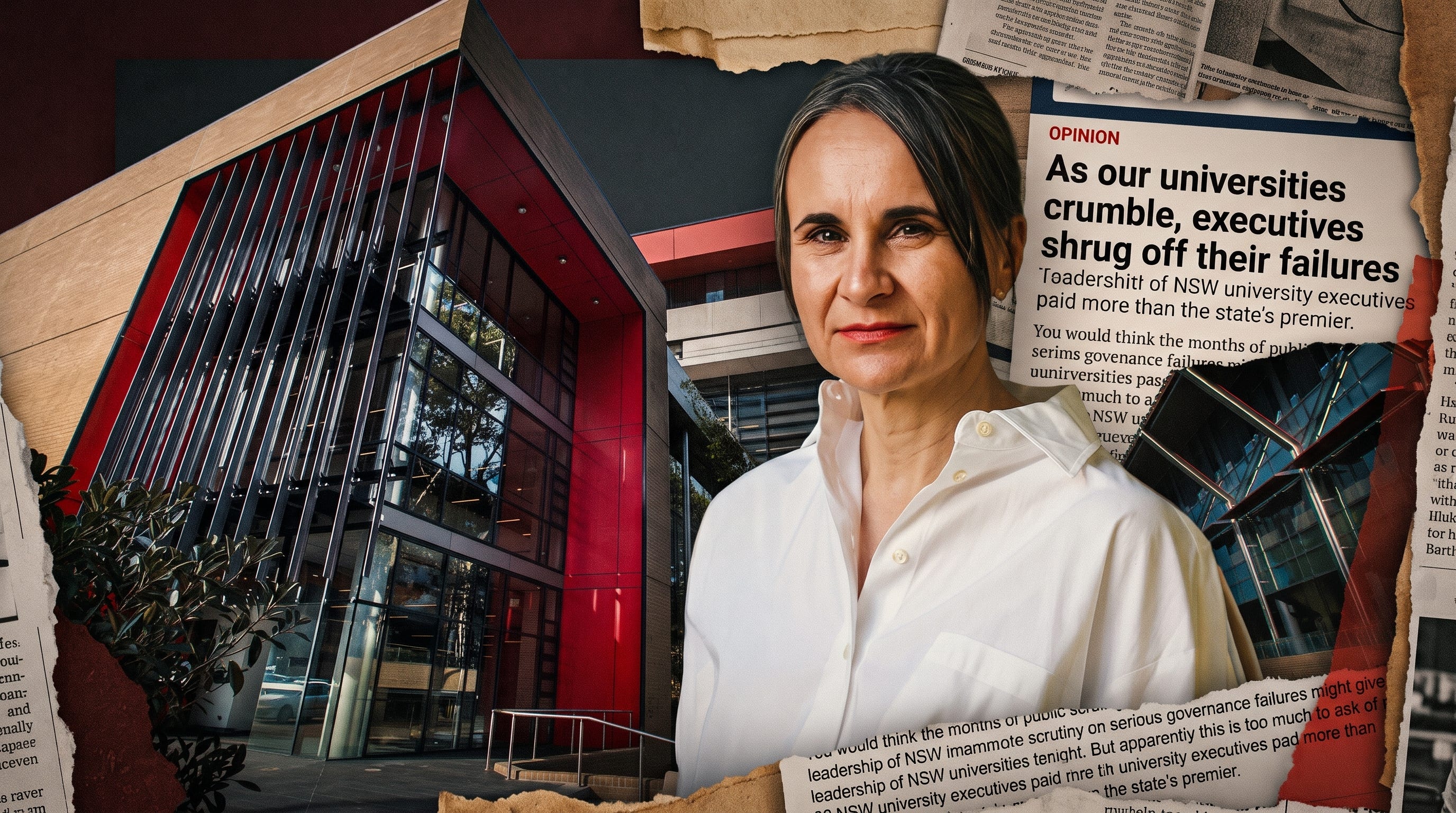
The University of Wollongong and the University of NSW have rejected criticism from NSW Upper House MP Dr Sarah Kaine, who says university leaders responded to her parliamentary inquiry with a defiant 'business as usual' posture bordering on contempt.
Dr Kaine, a Labor MLC who chaired the Standing Committee on Social Issues inquiry, aired her criticisms this week. Her committee’s 310-page report, tabled on September 21, found university governance across NSW “not fit for purpose”.
The debate comes as the Independent Commission Against Corruption (ICAC) prepares its final report on Operation Scandi, its investigation into UOW governance and recruitment. ICAC has made no findings, and individuals named in hearings face allegations only.
Search for new chancellor
In her article, Dr Kaine questioned why UOW’s Council is leading the search for a new Chancellor despite being largely the same body that presided over the governance failures probed by ICAC.
Former Chancellor Michael Still stood aside on June 5 before resigning on July 3, during the ICAC hearings. His departure triggered the search.
A UOW spokesperson rejected that claim as “not accurate.”
“The current Council is not ‘largely the same Council’ that was in place during the period examined by ICAC,” the spokesperson said. “Of the 13 current Council members, 10 joined in 2025 or 2026, representing substantial renewal of Council’s membership.”
“Under the University of Wollongong Act and By-law, the Chancellor is elected by the full Council. This is the statutory process the University is required to follow,” the spokesperson said.
Vice-Chancellor Professor Max Lu mentioned the same in an opinion piece published first in the Illawarra Mercury, then on UOW’s website on October 22. Professor Lu wrote that five members joined in 2025, five joined in 2026, and five of the 13 are staff and student representatives. He acknowledged calls for Council members to step aside, warning this would leave UOW unable to approve budgets or make major decisions.
Back in July, former UOW Work Health and Safety Committee chair Lisa Simmons called on Council to resign, telling The Pulse the governing body had lost community confidence following ICAC hearings. Ms Simmons demanded the Chancellor search pause until councillors’ “integrity, independence, competence and fitness” were independently examined.
Those calls have been reiterated regularly in the months since - by the National Tertiary Education Union’s NSW Division and UOW branch, as well as South Coast Labour Council secretary Arthur Rorris.
The Chancellor Nominations Panel, the UOW spokesperson said,includes an independent external member, Professor Peter Shergold AC, and is responsible for overseeing the search and assessment of potential candidates. The panel does not appoint the Chancellor; that decision rests with the full Council.
UOW expects to complete the appointment by late 2026 or early 2027.
The $169m housing deal fallout
In the article Dr Kaine pointed to 2021, when UOW restated its accounts to record a previously undisclosed $169 million expense from a terminated student accommodation public-private partnership, while a partner at internal auditor KPMG sat on Council.
The NSW Audit Office treated the restatement as a retrospective correction of a prior-period error, finding the legal liability arose in 2020. UOW stated it entered the 2014 partnership to build two student accommodation facilities, but terminated in late 2020 after COVID-19 impacted international enrolments and occupancy penalties mounted.
After consultation with the Audit Office, the restatement lifted UOW’s 2020 operating deficit from $48.8 million to $217.8 million. UOW says the assets returned to its control and generated roughly $45 million in cumulative cash surpluses over the five years to 2025.
On KPMG’s involvement, a UOW spokesperson said: “The University’s financial statements, including the accounting treatment of the termination, were externally audited by the NSW Audit Office, not by UOW’s contracted internal audit provider, which at the time was KPMG.
A KPMG partner was a Council member at that time but was not a member of Council’s Risk, Audit and Compliance Committee, which oversees the internal audit function.”
However, the statement did not address the Finance and Infrastructure Committee. A submission to a Senate inquiry into university governance by Emeritus Professor James Guthrie and Dr Adam Lucas notes that the same Council member sat on that committee, which reviewed the 2020 financial statements.
KPMG was approached for comment and declined to speak on the record.
UNSW defends $40m IT contract
Dr Kaine also questioned the University of NSW for reportedly awarding a $40 million IT contract to KPMG despite ongoing government procurement bans.
A UNSW spokesperson defended the engagement, stating the university ran an extensive competitive tender taking over a year to select a system integrator for core administrative IT upgrades.
“Appointing a system integrator is routine for large-scale IT projects, recognising that the skills required to implement them successfully are specialised and time limited,” the spokesperson said, adding that UNSW’s procurement policies align with NSW government directives on consultants.
Scrutiny continues
Universities across NSW are facing growing pressure to reform their governance. The NSW Upper House inquiry scrutinised the $139 million spent on consultants across NSW public universities in 2025. It recommended that councils comprise 50 per cent elected staff and students. It also raised serious concerns over former UOW interim vice-chancellor John Dewar, concluding there were discrepancies between his evidence to the committee and his subsequent testimony at ICAC.
UOW says its governance reset began in early 2026, with over half of its 42 actions completed or underway. UOW will map ICAC’s recommendations against the program once the commission hands down its final report.
The Minns government has until late December to respond to Dr Kaine’s inquiry findings.