


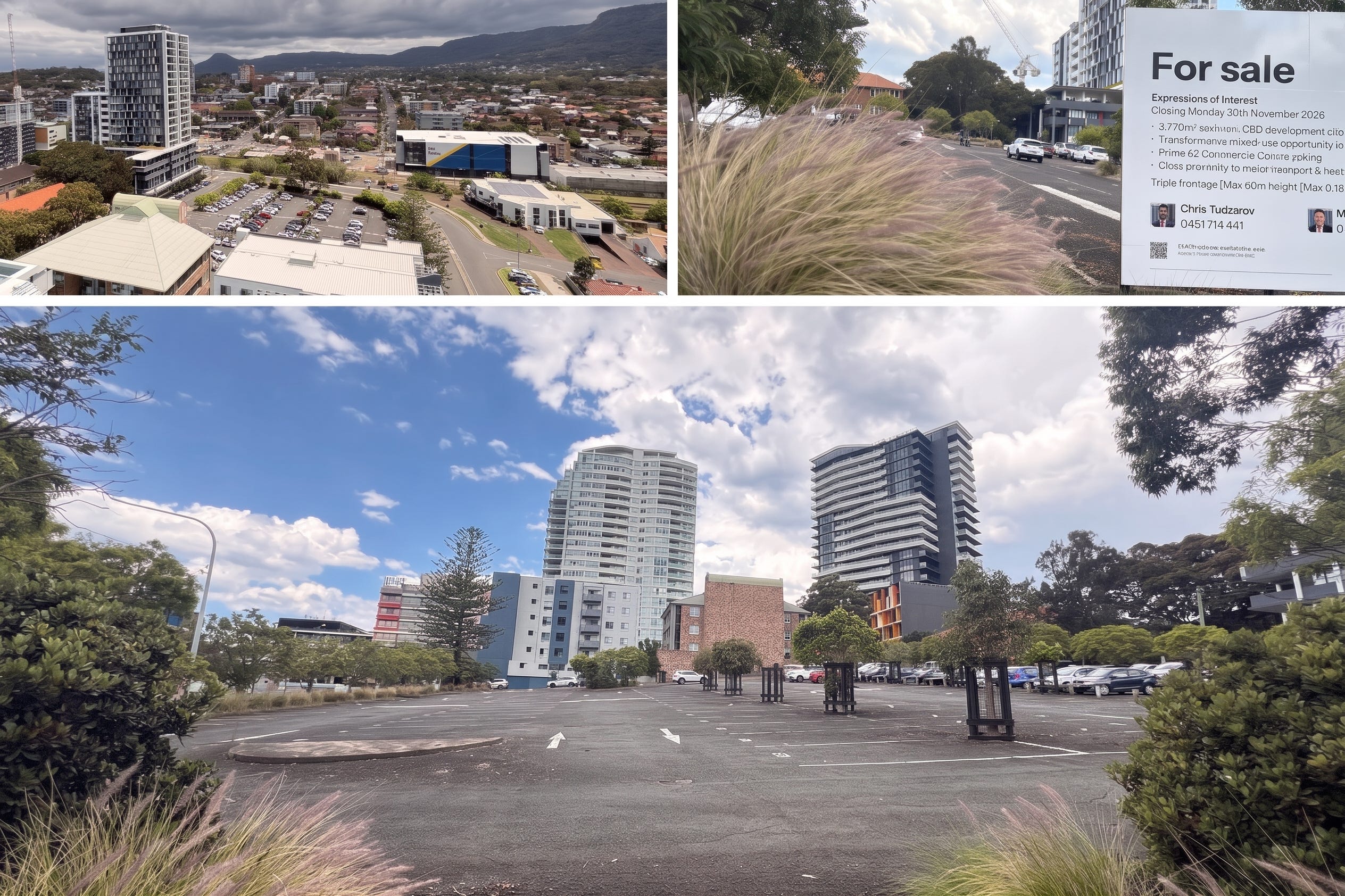
Wollongong City Council has voted to legally lock in 195 public parking spaces at Rawson Street. It’s a move the Lord Mayor admits is “shooting for the moon” alongside hopes for affordable housing and childcare, and one a property expert warns could blow out construction costs.
At Monday night’s council meeting, councillors unanimously voted to place a positive covenant on the city-centre site, which comprises 33 metered spaces and 162 spaces currently licensed to the public.
However, following a question from Cr Ryan Morris, council staff confirmed during debate that the covenant will not force a buyer to keep parking free.
“It would be an opportunity for the developer to decide how they actually manage that site, so it could be paid public parking,” council’s property manager Roisin O’Sullivan told the chamber. “It may not be free public parking, so that would be up to them how they use it and how they develop it.”
Lord Mayor Tania Brown said the council was “shooting for the moon” with its wish list for the site, but said the permanent parking covenant was necessary to reassure the community.
“I know Wollongong doesn’t have a parking problem; it has a parking perception problem, and the genuine fear that we’re going to lose another car park,” Cr Brown said, before adding: “If we don’t get what we want, we don’t have to progress.”
Colliers Wollongong managing director Simon Kersten said delivering 195 spaces - particularly if a developer has to excavate underground basement levels into hard rock rather than build above-ground parking - adds substantial extra cost at a time when apartment projects are already struggling to stack up.
Cr Kit Docker pulled the item from the block of items adopted together to question staff. While he supported the motion, he argued affordable housing and childcare were more important than parking, which he called “an inconvenience”.
Council’s call for expressions of interest closes on November 30.
Why history matters
The 5500-square-metre site near Wollongong Train Station has a fraught history.
Council sold it for $6 million in 2003 for a proposed $120 million private hospital and aged care complex—which included handing back 155 parking spaces—before buying it back for $6.1 million in 2008 after the developer collapsed into liquidation during the global financial crisis.
Mr Kersten warned when plans for the site were revealed in October that the council would want “tighter control over the contract and the terms” this time, adding that attaching public uses would make sale negotiations “more complicated, but … not impossible”.
Any sale would require a further council decision, with proceeds going to the council’s property investment fund.