


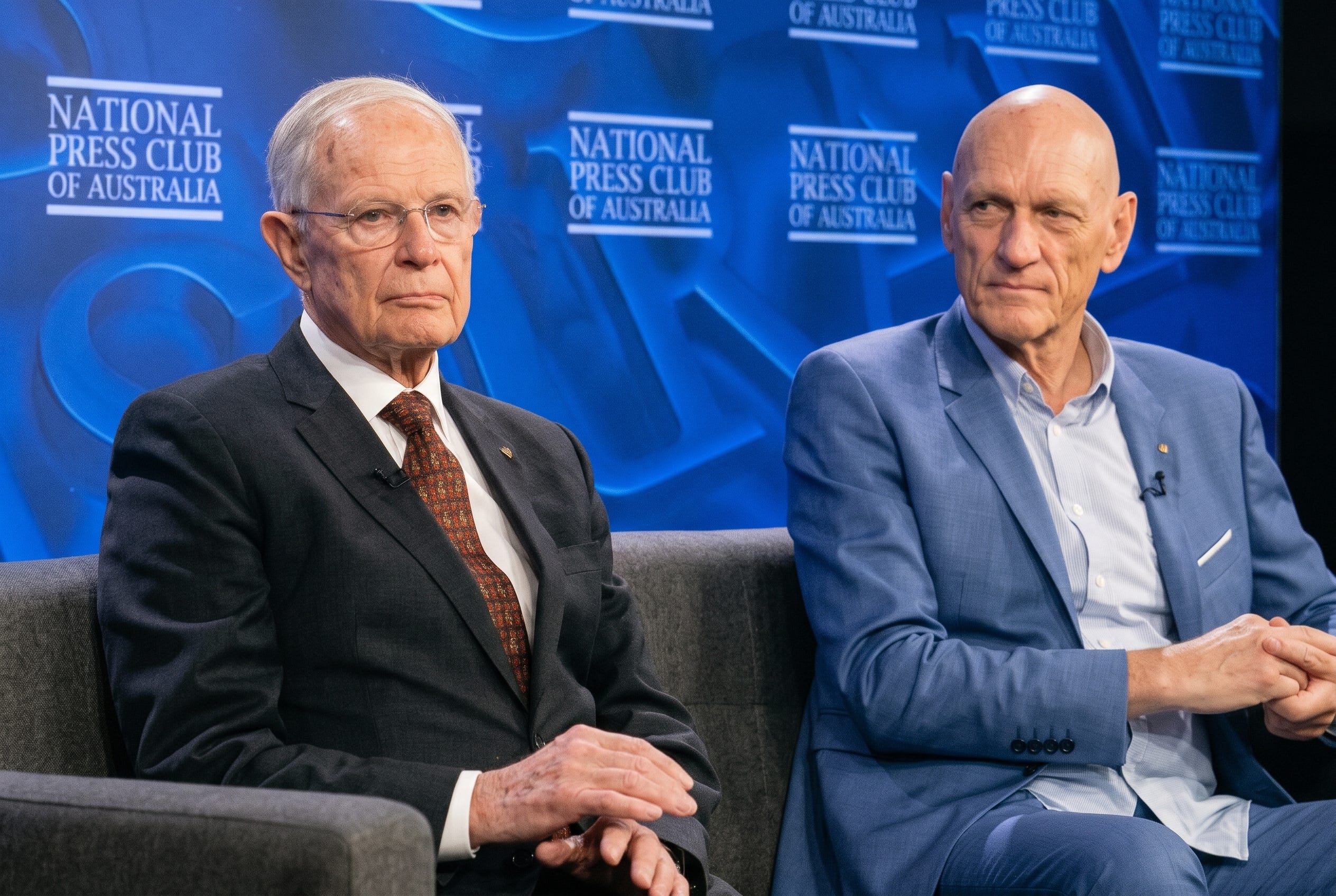
Former Labor minister Peter Garrett has called the AUKUS submarine deal “a complete, absolute crock” and said Port Kembla is the most likely east coast base if it goes ahead.
Garrett, a commissioner on an unofficial public inquiry, spoke at the National Press Club in Canberra on Wednesday alongside former Chief of the Defence Force retired admiral Chris Barrieas they released the inquiry’s report, Surrendering Australia: The AUKUS Deception. The report says AUKUS is “the worst, most costly, and riskiest defence decision ever made by an Australian government” and recommends ending the submarine component, known as Pillar One.
Port Kembla feeling ‘strong’
Asked to explain the basis for his view on Port Kembla, Garrett said documents released under Freedom of Information in the NSW Parliament. They showed governments, including the state’s, had examined a fleet base there, he said. Newcastle faced growing opposition and heavy shipping traffic, and the size of the planned submarines would cause problems in Brisbane.
“So that, by default, sends you back to Port Kembla, where community feeling is extremely strong,” he said.
“The community has sought for Port Kembla to be ruled out as a potential east coast base, and from my understanding, up to this point in time, no government has been willing to do that.”
Garrett said the reasoning was “very general” and not something the inquiry had examined.
Admiral Barrie said people in the communities the panel visited “knew that something had been done”, but that without government disclosure “we don’t know what they’ve actually decided”.
Cost and waste
The government puts the program at up to $368 billion over 30 years. The inquiry bumps that up top around half a trillion dollars, which Garrett said includes about $180 billion for radioactive waste management and burial.
Admiral Barrie said Australia has agreed by treaty to dispose of spent fuel from the submarines, but it is not known how or where. After six decades neither the US nor the UK has a permanent disposal site, he said.
Garrett said Australia is helping fund UK and US construction facilities through a preliminary budget “approaching $9 billion”, and that it indemnifies both countries against claims concerning nuclear risks.
An alternative path
The commissioners set out a clear alternative transition path, recommending Australia call an immediate halt to AUKUS Pillar One, suspending base developments at Stirling and Osborne, while establishing a Royal Commission and a forensic Australian National Audit Office audit to probe expenditures and declassify the 2022 climate risk report. In its place, Plan B would keep the navy’s existing fleet of six Collins-class submarines operational beyond their planned retirement dates and consider low-risk subs or diesel-electric engines.
The commissioners said the government, the opposition and serving Defence staff did not take part. Garrett said he had written to Prime Minister Anthony Albanese twice.
The Commissioners’ Report of the AUKUS Public Inquiry can be read in full.
Read the report or Download fast facts ↓
About the AUKUS Public Inquiry …
What was the inquiry?
It is an independent, non-aligned, panel established under the auspices of the Australian Peace and Security Forum. Its intent was to provide public consultation that critics argue both the Coalition and Albanese governments bypassed when entering into the partnership. The initiative crowd-funded $220,000 for the inquiry.
Core aims, terms of reference
The inquiry was tasked with addressing the central question: “Will AUKUS keep us safe – and at what cost?”. It examines the strategic rationale of acquiring nuclear-powered submarines, the transparency of intergovernmental pacts, regional geopolitical risks, non-proliferation and nuclear waste management liabilities, and the opportunity costs of diverting massive public revenues away from domestic social and physical infrastructure.
Who are the commissioners?
The inquiry is spearheaded by a five-member panel spanning former senior military leadership, governance, academic, and First Nations backgrounds:
The Hon Peter Garrett AM FTSE (lead commissioner)
Admiral Chris Barrie AC RAN (Ret’d)
The Hon Dr Carmen Lawrence AO
Hearings, reach & submissions
Since launching in June 2026, commissioners conducted 10 day-long hearings across eight cities. The panel gathered testimony from former prime ministers, former defence and foreign affairs ministers, senior military analysts, defence economists, union representatives, and local residents. In total, the inquiry reported receiving more than 1000 written submissions and nearly 10,000 participants and live-stream viewers.
Have you completed the survey?
Help us shape the state election coverage you want to actually read

With the NSW state election on March 13 (and the summer break right around …