

Seven things we learned about UOW in the State Inquiry into NSW University Sector
We’ve reviewed the uncorrected transcript of the inquiry and pulled out the seven moments, figures and exchanges that stood out most.

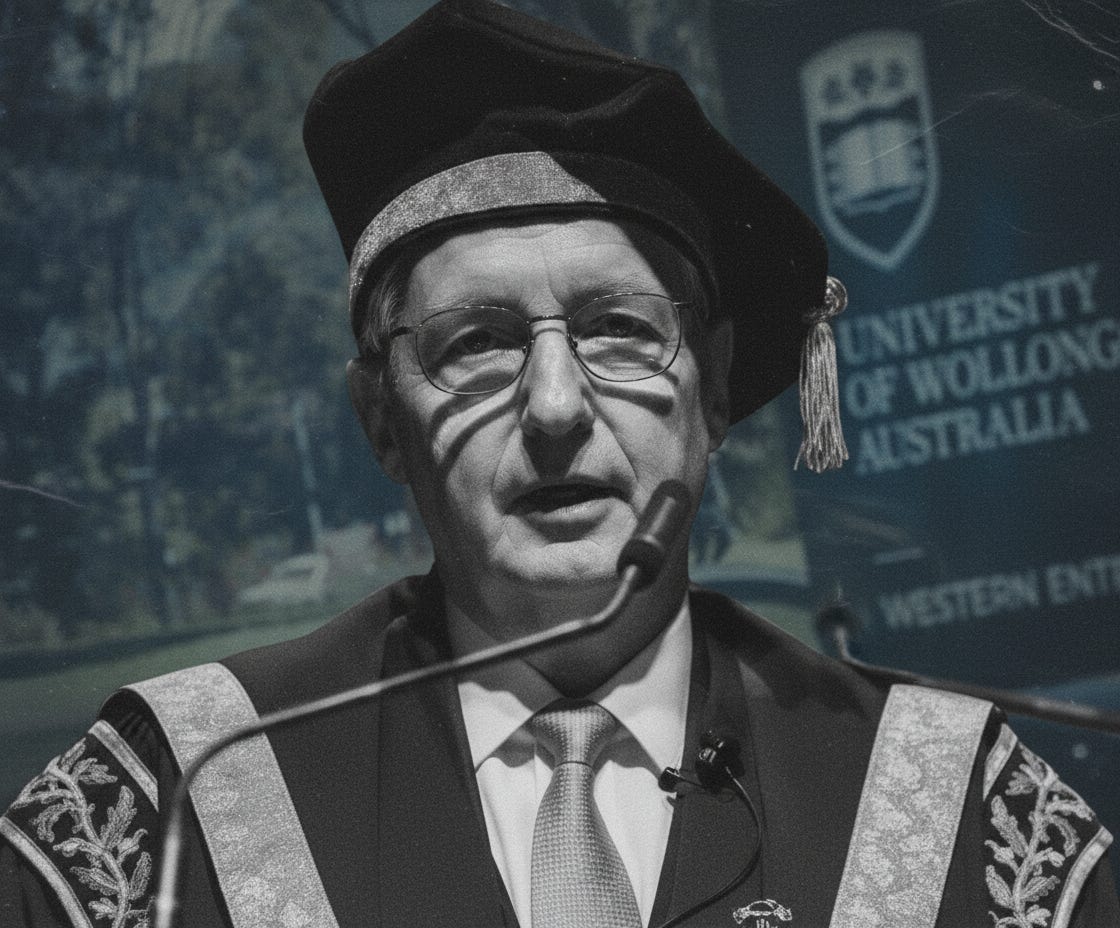
Cast your mind back to the final days before Christmas. Many people were rushing to tie up loose ends before a summer break, and it’s likely some missed the details of a State Inquiry that placed the University of Wollongong firmly under the microscope.
On December 17, the NSW Parliament’s Standing Committee on Social Issues held a full day of hearings at Parliament House as part of its State Inquiry into the university sector. The hearing, chaired by Dr Sarah Kaine, focused extensively on the University of Wollongong (UOW).
The committee heard evidence from current and former UOW staff and leaders, including Chancellor Michael Still, Professor Fiona Probyn-Rapsey, Associate Professor Susan Engel, Honorary Senior Fellow Adam Lucas and former senior manager Lisa Simmons. Current Vice-Chancellor Professor G. Q. Max Lu also appeared before the inquiry, alongside Deputy Chancellor Warwick Shanks and Professor Nina Reynolds, Chair of Academic Senate at UOW.
Their evidence lifted the lid on governance changes leading up to the resignation of former vice-chancellor Patricia Davidson, as well as the impact of recent restructures and commercial ventures on staff, students and the university’s finances.
We’ve reviewed the uncorrected transcript of the hearing and pulled out the seven moments, figures and exchanges that stood out most.
Probing the university’s finances
From warnings that the university would “run out of cash” within years, to the cost of senior ceremonies and redundancy payouts, exchanges with Chancellor Michael Still revealed how financial pressure, executive oversight and spending priorities collided under questioning.
Still said UOW was on track to run out of money by 2027 when questioned about the increase in centralisation.
“The university was, at that stage of the game, going to run out of cash in 2027. That’s not a situation that I can sit by and watch, and allow to go through slow or undeveloped processes. Of course, council needed to take a much greater interest,” he said.
It was later revealed that $62,000 was spent on Still’s installation ceremony in August 2024 - the first such ceremony held by the university since 1975.
Still said he didn’t know how much the ceremony had cost or who had approved it.
“I would have thought that was unfortunate, I must say. I didn’t know that at all. What transpired, as I was advised afterwards, was that internal people wouldn’t cooperate in putting together that installation ceremony and it was outsourced. I hadn’t known that.”
Still later said it was a surprise that almost $300,000 was reportedly spent on his incidental expenses, including staff, parking, and the inauguration.
He confirmed that the position of Chancellor is voluntary and that he spends 40 hours a week in the role, but said he pays his own expenses.
“I spend absolutely as little as I can. I drive my own car. I pay my own expenses. I’m very surprised at $300,000, but we will find out what it’s spent on.”
Further questioning revealed that more than $29m had been paid out in redundancy payments, with an extra $700,000 in hiring costs during the first 18 months Still served as Chancellor from the end of 2023 to mid-2025.
Research grants became difficult to access
Former National Tertiary Education Union Branch President at the University of Wollongong, Professor Fiona Probyn-Rapsey, told the inquiry that researchers in recent years were prevented from accessing grant funding, estimated at $45m, that had already been awarded through competitive national processes.
She told the inquiry that plans to address the university’s financial shortfall included “placing restrictions on research expenditures”.
“Academics were suddenly faced with a whole raft of obstacles placed in the way of spending their research money. Many academics experienced this, where they were having to ask permission to access their grant money, and, prior to this, never having to do that,” she said.
She linked the restriction directly to the presentation of the university’s finances.
“So you can see why rumours started to circulate that this was a way that UOW could bolster its accounts for that year. By restricting the expenditure of that money, it made their finances look a whole lot healthier.”
Vice-Chancellor Patricia Davidson’s departure
The inquiry also examined changes to executive authority that occurred shortly before the resignation of former Vice-Chancellor Patricia Davidson.
Former executive manager of Faculty Research Operations and former chair of the Work Health and Safety Committee at UOW, Lisa Simmons, told the committee that authority over senior executive appointments and disestablishments was removed from the Vice-Chancellor and transferred to the Performance and Remuneration Committee, chaired by the Chancellor.
“This takes a significant amount of power out of the Vice-Chancellor’s hands to manage the university, as the Act describes, and puts it into the hands of the Chancellor,” she said.
“Three weeks later, Professor Patricia Davidson announces her resignation.”
The timing of those changes was explored during questioning of Chancellor Michael Still by committee members. Member of the Legislative Council, Anthony D’Adam asked directly whether Still had initiated a discussion with Davidson about her resignation.
“My question is, did you initiate a discussion with Professor Davidson about her resigning, asking her to resign?” D’Adam said.
Still responded: “The conversation I had with Professor Davidson did include the possibility of her resigning, and she resigned.”
The impact of voluntary redundancies
Evidence suggested staff redundancies were often presented after key decisions had already been made, leaving little scope for genuine choice or consultation.
Professor Probyn-Rapsey, who left the university on voluntary redundancy in February 2025, told the committee the language used did not reflect staff experience.
“I think the phrase ‘voluntary redundancy’ becomes a bit painful to staff who go through the process, because it does imply that it was a gracious move on behalf of the university to allow us to leave,” she said.
“In my case – and I think it was a common experience – there was clearly a plan to disestablish one of the disciplines that I teach in, and it was very much presented as a fait accompli,” she said.
She also described redeployment offers that did not preserve role equivalence or seniority, giving one example where “a professor was offered a Level A 80 per cent teaching position”, which she said was the equivalent to a tutor role.
Associate Professor Susan Engel, who also appeared as Wollongong branch president of the National Tertiary Education Union, told the inquiry how redundancies unfolded during a major organisational transformation.
“We lost about 160 staff through so-called voluntary redundancies,” Engel told the inquiry.
She said that staff who remained were required to implement changes that had already been determined. “We were expected to implement very significant changes with no support,” Engel said.
Engel also told the committee that the restructures meant many staff simply did not want to stay.
“The results so far is that there’s been around 160 so-called voluntary redundancies been paid out, a net headcount reduction of around just under 100 full-time equivalent staff. But there are also 144 vacancies being advertised, many of which are already on the UOW website, because the process has resulted in so many people leaving or losing - not wanting to stay,” she said.
Engel said the process had consumed enormous staff time: “The whole restructuring process has yet again consumed thousands and thousands of staff hours, distracting from core university business and, in our view, has produced really dysfunctional outcomes.”
The breakdown of accountability
The inquiry also heard evidence about organisational culture and internal challenge.
Former senior manager Lisa Simmons told the committee that appearing before the inquiry carried risk.
“For professional staff like me, appearing before an inquiry like this is seen as the ‘nuclear’ option; it carries very real personal and professional risk,” she said.
She described an environment where governance and assurance mechanisms were no longer effective.
“In early 2025, colleagues began sharing their experiences with me of pressure, intimidation and ethical compromise. The volume of information and their trust compelled me to act.”
Simmons said she made a voluntary disclosure to the Independent Commission Against Corruption, relating to a “suspicion of corrupt conduct and/or suspected wrongdoing”.
Debt on the books
The inquiry also examined a failed public-private partnership for student accommodation. Honorary Senior Fellow Adam Lucas told the committee that the deal’s structure left UOW bearing the financial impact of a $169 million accounting revision when international student numbers fell during COVID-19.
“The university had to pay out its project partner,” Lucas said, describing the arrangement as reflecting “a poor risk assessment”.
The agreement was ultimately terminated, and the university repurchased the assets and assumed the remaining debt, which remains on its books.
Lucas told the inquiry that the financial consequences were ongoing.
“We’re still paying interest on that now,” he said.
“We’re paying about $21 million in interest on loans that have been [inaudible] for construction purposes.”
Interim Vice-Chancellor John Dewar’s appointment
The inquiry also heard evidence that sharpened scrutiny on the appointment of John Dewar as interim Vice-Chancellor of the University of Wollongong, particularly around timing, transparency and potential conflicts of interest.
Evidence established that Dewar was appointed on June 20, 2024. Just over a month later, on July 22, consulting firm KordaMentha commenced work for the university, undertaking operational and financial reviews worth $2.9 million.
Witnesses told the inquiry Dewar remained a business partner at KordaMentha during this period. Probyn-Rapsey said a subsequent access-to-information request clarified the arrangement.
“A GIPAA revealed that he was doing a nine-day fortnight with one day set aside for KordaMentha,” she said.
Committee members examined the arrangement with Still saying Dewar “possibly used that one day a fortnight to keep in touch with people that he would go back to KordaMentha with.” He added that the university insisted there was no working relationship.
Dr Kaine pressed the issue: “Given that I understand John Dewar remained a business partner at KordaMentha, he was still profiting from the business that KordaMentha had at the University of Wollongong.”
“Even if you put up that screen, if you like, between him not engaging, he still was a beneficiary of the work.”
Still responded: “Possibly. I don’t know.”
A spokesperson from UOW said: “The University of Wollongong welcomed the opportunity to participate in the NSW Parliamentary Inquiry into the university sector because we recognise that trust in our universities is fundamental.
“Strong governance, balanced with the freedom to innovate, is essential, and we are committed to accountability, transparency and high performance. These values underpin our role in national policy discussions, our partnerships with local industry and government, and above all, our service to students and the community.”
The parliamentary inquiry into the NSW tertiary sector crisis continues on February 18.