


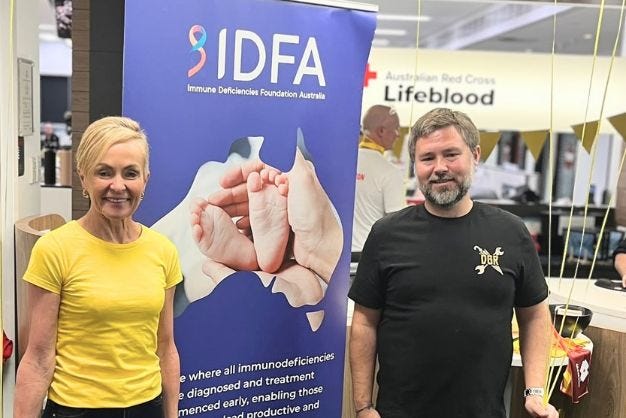
Every month, Steve Karil spends two to three hours at Wollongong Hospital receiving a life-changing infusion.
Behind a year of treatment are about 130 plasma donations, and the people who give their time without knowing whose health they help protect.
On Friday, October 9, Wollongong’s Lifeblood donor centre brought those two sides together, hosting a “Plasma Party” where donors could meet people who depend on plasma-derived medicines.
For Steve, 40, the difference has been fewer infections and better health after years of recurring illness.
“I was getting pneumonia and chest infections once or twice a year and just always getting the common cold,” he said.
“I don’t think I’ve had a chest infection since I’ve been on it.”
He usually passes the time during treatment with a movie, work or emails on his iPad.
“It’s definitely been a … big life changer,” he said.
The event, organised by Immune Deficiencies Foundation Australia (IDFA) and Australian Red Cross Lifeblood for International Plasma Awareness Week, came as local donation bookings declined.
Lifeblood area manager John Bain, who oversees Wollongong and Sydney, said the Wollongong centre hoped to welcome more than 90 donors on Friday, with about 100 possible on a particularly busy day.
“Truthfully, lately, it’s been tough. Bookings are down, and we haven’t been reaching those heights,” he said.
“But obviously, today, with a bit of extra excitement and a bit of a push, we’re doing well.”
Bain said Australians responded generously to major appeals and tragic events. The challenge was maintaining that generosity throughout the year.
“I would say people don’t realise how long it’s been since they last came in and saw us,” he said.
Plasma is a component of blood that can be used to make up to 18 different medicines and treatments, Bain said. Donors can give plasma fortnightly, compared with every 12 weeks for whole blood.
IDFA chief executive Carolyn Dews said the organisation supported people with primary and secondary immunodeficiency, whose immune systems do not function as they should.
Many members receive immunoglobulin medicines produced using donated plasma.
“On average, it takes around 130 plasma donations each year to treat just one person with a primary immunodeficiency,” Dews said.
The annual partnership with Lifeblood helps explain that ongoing need while giving donors a chance to see the difference their contribution can make.
“We’re encouraging anyone who’s not a donor to perhaps pop in sometime next week, check if they’re eligible, and if you can start to donate, please do,” she said.
For Steve, meeting the people behind those donations was a reminder of how many strangers contribute to his wellbeing.
“It’s pretty amazing seeing all those people that just donate their time for something that can make a big difference,” he said.
Donation appointments at Wollongong’s Lifeblood centre, at 1/45–53 Kembla Street, can be booked through Lifeblood.