The $500,000 logistics mission to bring John Travolta’s Boeing 707 home
The historic Boeing 707 has arrived at Port Kembla after a complex nine-year mission to bring John Travolta’s former Qantas jet to its new home in the Illawarra.

After a 35-day journey across oceans and through some of the world’s busiest shipping routes, one of the most famous aircraft ever linked to Australia has finally arrived at Port Kembla.
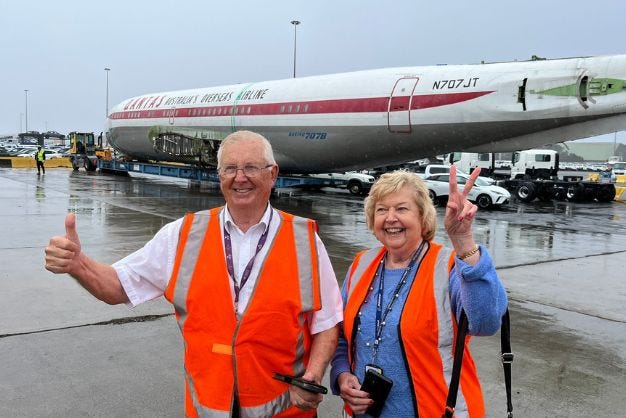
But while the sight of John Travolta’s former Qantas Boeing 707 rolling off a cargo ship drew crowds at Port Kembla on Wednesday, May 13, the complex logistics operation behind it has been years in the making, and it has one final challenge still ahead: getting the aircraft the last few kilometres to Albion Park.
The massive aircraft fuselage, weighing about 60 tonnes and stretching roughly 40 metres long, is now sitting just 17 kilometres away from its final destination at the Historical Aircraft Restoration Society (HARS) museum at Albion Park.
For Stephen Hearty, the man coordinating the complex operation for Australian-based freight company AAW Global Logistics, the arrival at Port Kembla marks the culmination of months of planning — and $500,000 in logistics costs.
“It’s definitely been more interesting,” Mr Hearty said.
“I’m really humbled they asked me to jump in and help them out with this.”
The aircraft, a rare Boeing 707-138B built specifically for Qantas, was donated to HARS by actor and aviation enthusiast John Travolta in 2017.
Chair of the HARS Foundation is Maureen Massey explained that the original plan was to fly the aircraft from the United States to Shellharbour Airport under its own power. But after years of engineering complications, regulatory requirements, COVID delays and mounting restoration costs, HARS made the difficult decision to dismantle the aircraft and transport it to Australia by sea instead.
“It was an agonising decision. It took us about six months to decide, but we decided the safest thing was to ship it out,” she said.
That decision launched a logistical puzzle unlike almost anything regularly handled through the Illawarra.

The fuselage alone was loaded onto an 80-foot Mafi trailer aboard the Wallenius Wilhelmsen vessel Thermopylae in Brunswick, Georgia, before beginning a voyage that travelled through the United Kingdom, Panama, New Zealand, and Brisbane, finally arriving at Port Kembla.
Alongside the fuselage came wings, landing gear, engines, flaps and thousands of individual aircraft components. Many had already arrived in Australia earlier inside 10 shipping containers.
“I’ve been trying really, really hard to plan for contingencies — and contingencies for the contingencies — to make sure if anything goes wrong, I already have a plan in my head,” Mr Hearty said.
“It’s the last mile right now … I’m happy that it made it here all in one piece.”
The operation has involved months of planning between shipping operators, transport companies, customs authorities, biosecurity teams and aviation engineers.

According to Paul Rabbas from Qube, planning for the arrival at Port Kembla began back in January.
Crews had to calculate the aircraft’s exact weight, length, overhang clearance and ramp angles before the fuselage could even be unloaded safely from the ship.
Because the aircraft extends well beyond the length of the transport trailer beneath it, crews were forced to move it slowly
and carefully down the vessel ramp to avoid striking the overhanging tail section.
“We had to consider everything,” Mr Rabbas said.
“The height, the weight, the length, the overhang - even tidal charts.”
The final leg may prove the most delicate of all.
The fuselage is expected to leave Port Kembla under police escort in the early hours of May 20, travelling by road to the HARS Aviation Museum at Albion Park.
There, volunteers will spend months rebuilding the aircraft piece by piece.
For HARS vice-president Maureen Massey, finally seeing the aircraft arrive in Australia after nearly nine years was emotional.
“It’s been a lot of heartache, a lot of worry, a lot of tears and money,” she said.
“And to see this in fruition now, it’s just amazing.”
While HARS colleague Bob De La Hunty is already focused on next steps. He took a walk around the fuselage and started measuring up just minutes after the plane was parked.
“For the next six months we’ll be putting it all back together again. It’s a huge Meccano.”
Adding that it would take time to get the plane back up and running, but once it was ready to taxi, Travolta was keen to get back behind the wheel.
“That’ll be a major, major event and occasion.”
The back story
The Boeing 707-138B now at Port Kembla carries nearly two decades of ambition and setback for Albion Park’s Historical Aircraft Restoration Society (HARS), a respected volunteer organisation at Albion Park. Built in 1964 and delivered to Qantas as City of Launceston, it eventually found its way to Travolta, one of Hollywood’s aviation obsessives.
The connection between the Pulp Fiction star, a qualified pilot and Qantas ambassador, and HARS dates to 2009, when president Bob De La Hunty took him flying on the museum’s restored Super Constellation and quietly suggested that if he ever parted with his 707, HARS would be interested. Eight years later, Travolta made good.
Certification hurdles, restoration costs, and COVID killed plans for Travolta to fly the jet to Australia himself. Stored in Georgia since 2016 and quietly deteriorating, the 707 eventually forced a pragmatic rethink: if it couldn’t fly home, it would sail.
The final leg: the Port of Brunswick to Port Kembla

The US operation began three months ago when a three-person team from Nebraska-based Worldwide Aircraft Recovery started carefully dismantling the plane, which had been stored at Brunswick Golden Isles Airport in Georgia since 2016.
For the 16,000km sea voyage to Port Kembla via the Caribbean, Panama Canal, New Zealand and Brisbane, the aircraft’s wings, tail and engines were removed from the fuselage.
Vice-president of operations Jay Penry said the Boeing 707 presented challenges because it had to be reduced to just the right size to fit aboard the ship.
“We have successfully relocated thousands of historic aircraft, so being able to save another one is great,” he said.
The firm specialises in dismantling, transporting and reassembling aircraft for museums and aviation organisations preserving historic planes for display or training.