

The big questions industry put to government at the Future of Housing Summit
If you couldn't make it, here's what you need to know about Business Illawarra's Future of Housing Summit.

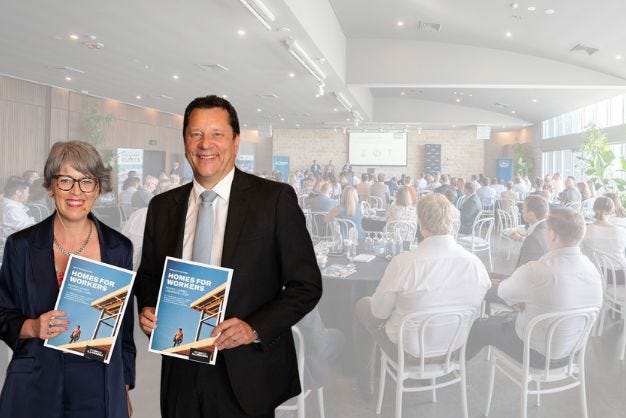
Developers, planners and business leaders used Business Illawarra’s Future of Housing Summit to push the NSW Government on a single question: not whether homes should be built, but how fast they can actually be delivered.
At the City Beach Function Centre forum in Wollongong on Friday, February 20, Planning Minister Paul Scully said delays remain the biggest driver of housing affordability.
“The big thing any state government can do is reduce time,” he told the audience, pointing to holding costs and financing pressures created during approvals.
The summit brought together councils, community housing providers and developers as the Illawarra prepares for major growth.
Minister for Housing, Rose Jackson, outlined her vision for integrated communities combining social, affordable and private housing, holding the proposals for Bellambi up as a standard to work towards.
You can read more about that conversation in Monday morning’s edition of The Pulse Illawarra.
Below we’ve lightly edited the question and answer session following Minister for Planning and Public Spaces and Member for Wollongong, Paul Scully’s address.
Questions ranged from transport-linked rezonings and childcare approvals to compliance confidence.
Question from Steve Ball, Legacy Property
The NSW government has made tremendous progress on reform and planning, and the process of unlocking the opportunity for more housing, which is fantastic. We’re really supportive of everything that you’ve done. My question is: in regard to delivery, does the government have plans or initiatives to help unlock?
A – Paul Scully
I appreciate every industry will seek to have a lower contribution to some things, but that shifts the burden. If it’s not paid through a contribution through one means, it needs to be paid through other means of consolidated revenue.
The big thing that any state government can do is reduce the time. Time is the biggest expense, whether it’s holding cost or interest in the line. That’s why we’re not only doing planning forms to speed things up and compress the time taken to get from an idea through to the delivery. We’re also backing that up with investments in the workforce to make sure we’re doing the workforce development at the same time.
We’re working through Minister Jackson to make sure that modern methods of construction and the productivity gains in the construction sector start to happen. The pre-sale finance guarantee is now being looked at. If we can get the whole system moving more quickly, that’s the part that reduces overall cost.
Question from Terry Weatherall, TCW Consulting
With the current review of the strategic planning framework and the increasing demand on housing and transport systems, is strengthening connections between regions — particularly north and south — a consideration?
A – Paul Scully
The new draft Sydney Plan has been simplified from over 800 pages to about 60 pages, and a key theme is stronger connections north and south.
When we release the draft of the Illawarra Shoalhaven plan, you’ll see that strong connection. At the moment it’s in the order of 27,000 people a day who are travelling from South West Sydney into the inner suburbs for work, or for educational or recreation.
If we don’t make that connection stronger in our strategic planning, we can miss the boat.
Question from Anita Kumar, ECTARC
Housing, health, and education are pillars that everybody needs, and you just spoke about how this region is going to grow. What I’d really like to understand is how early childhood education and care fit into this.
A – Paul Scully
“Childcare is one of the most complained-about things in the planning system. People somehow hate the idea of having a I just don’t get it.
“We’ve increasingly initiated rezonings incorporating an MV1 zone… so it provides the opportunity to do it, which hadn’t been done before.”
Question from Linda Davis, Director of Planning and Environment, Wollongong City Council
The states are really focused on changes to the planning processes available to them to accelerate zoning and development. Through those forms, you can do things that councils can’t necessarily do through our processes.
In a future trend, once you’ve done some of these initiatives, is there a thought to look back and start sorting some of those same things in councils to free up our processes?
A – Paul Scully
Earlier this week, we set out new guidelines for updating local environment plans, recognising that there’s often been too much work for what is actually needed. We’re ultimately looking to improve at the local government level as well.
Question from Coaralie McCarthy, Business Illawarra
When we talk about compliance and building certification, industry regulations can be confusing. Building codes and buyer standards keep changing, and confidence isn’t always there. How will you ensure compliance providers stay up to date and accountable?
A – Paul Scully
We’re doing some additional changes through the Building Act.
There’s a confidence thing that we need to instil. That’s why we expanded the resource in the building commissioner.
We need to make sure that the service provider is up to standard. So, we’re trying to tighten it up.
Question from Graham McCabe, STEP Advisory
Most of the stations in the Illawarra and the Princes Highway are in the R2 zone. If we want people to use public transport, we actually need to provide housing near the transport services. Will you be doing more rezones?
A – Paul Scully
What we’ve done is prioritise 37 second-tier and seven larger accelerated regions around the train stations.
We’ve also added 171 low and mid-rise areas around train stations and the town centres. So it’s going to be a mix of both. What we’ve worked with each of the local governments and council has been really good.
What we’ve done is prioritise the areas where we’ve got existing transport and infrastructure capacity, enabling water and wastewater to take up those first. So yes, they can be done in future. Yes, they can be rezoning proposals through strategic planning that councils can do.
We’ll continue to progress that, but of course, local government always encourages them to do their own strategic planning and go further.
In fairness to local government, they’re looking at options at the moment. which is why, earlier this week, Minister Jackson andIf released a guide for councils looking to use their own land as part of an affordable housing region in their area. We’re requiring everyone, through the city plan and broader plans, to update their local plan, strategic plan, schemes, and their affordable housing contribution.