The Illawarra's clean energy pivot: promise, progress and the gap in between
A pipeline problem looms for the region

The Illawarra has spent years being spoken of as a future clean energy hub - the industrial base with the infrastructure, the workforce, and the geography to lead Australia’s energy transition. The reality, assessed honestly in mid-2026, is more complicated.
Some of that promise has materialised in ways that are genuinely world-leading. Much of it has not. And the region’s single biggest clean energy bet - offshore wind - is now on hold for the foreseeable future.
Offshore wind stalls
The offshore wind story began promisingly. The federal government opened consultation on a 1,022 square kilometre offshore wind zone off the Illawarra coast in August 2023. More than 14,000 submissions poured in - a record - with 65 per cent opposed, citing concerns over visual impact, fishing, and property values. The zone was declared anyway in June 2024. The sole serious applicant, BlueFloat Energy, withdrew in 2023, citing global market conditions. No feasibility licences were granted.
Ty Christopher, director of the Energy Futures Network at the University of Wollongong, says the collapse is best understood as a global problem wearing a local face.
“These are multi-billion-dollar investments,” he explains. “It’s all a risk versus return equation, and quite deliberately, Trump’s behaviour has placed a much higher degree of risk over this investment.”
Christopher believes offshore wind will eventually return - “all of the reasons why it made sense here remain” - but is measured about the timeline: “The optimist in me says it’s a major delay. But realistically, we’re looking at five to 10 years.”
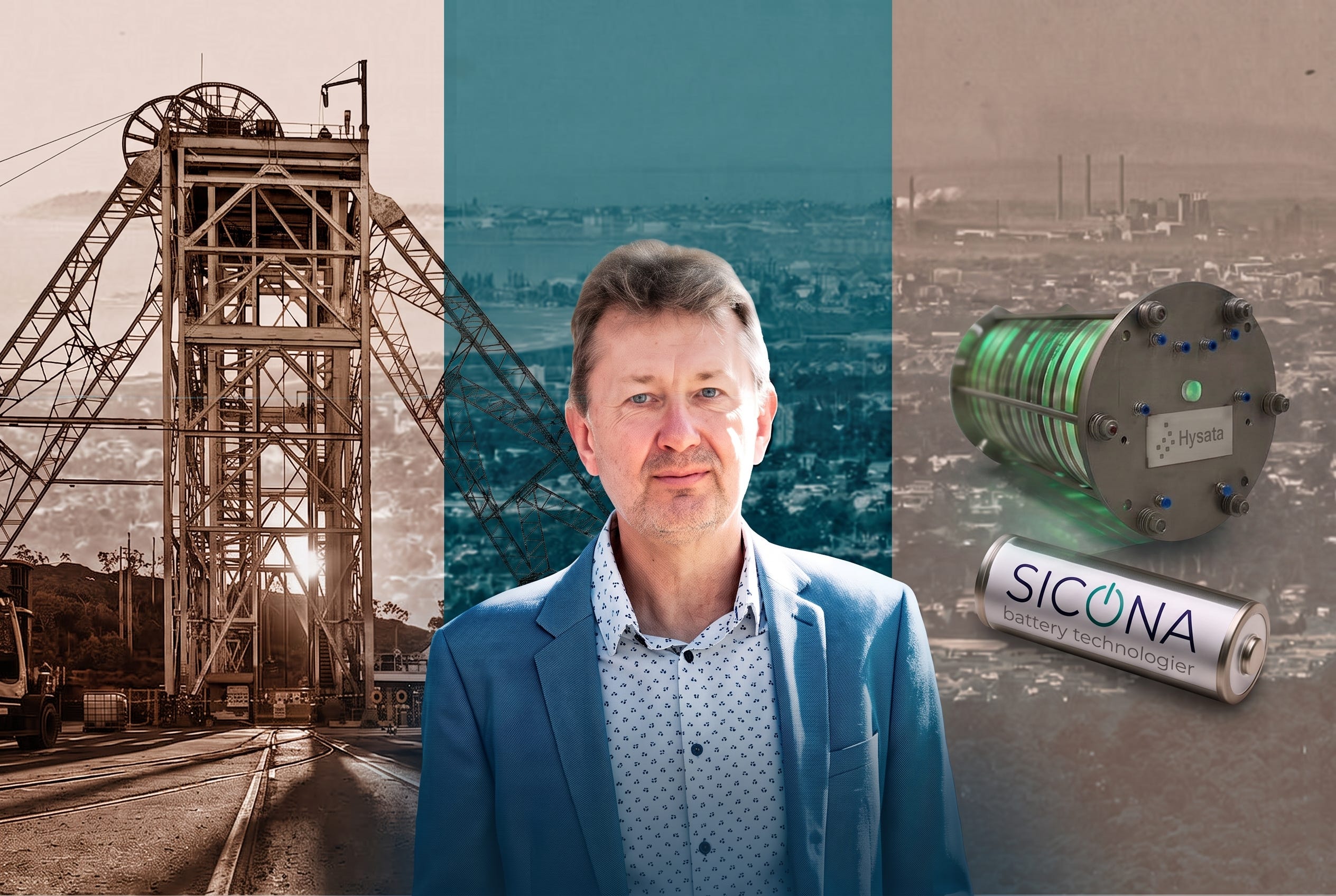
Federal member for Cunningham Alison Byrnes says the clean energy story extends beyond offshore wind. “Local companies like Sicona, Green Gravity, Hysata and others are developing world-leading technology right here in the Illawarra,” she says, adding the region’s “, skills, capability and drive are leading Australia’s clean energy transition”.
The claims have some public funding behind them. A previous round of the NSW Government’s Net Zero Manufacturing Initiative invested nearly $3.5 million in the region by December 2025, supporting early-stage projects at all three companies. Hysata has since signed its first megawatt-scale commercial order for delivery to an international customer in 2027.
Sicona secured a $45 million ARENA grant to scale up a silicon-carbon anode material which, the company says, increases battery energy density by more than 20 per cent and enables charging speeds more than 40 per cent faster than conventional batteries. The company has an exclusivity agreement with BlueScope to explore manufacturing at Port Kembla. Sicona did not respond to requests for comment.
Green Gravity is preparing to trial gravity-based energy storage at the Russell Vale mineshaft. CEO Mark Swinnerton says the technology fills a gap in the = transition to date. “Relatively little firming and dispatchable renewable infrastructure has been built to support the transition,” he says. Green Gravity addresses that “using existing industrial assets”.
And yet, as Christopher observes, the region has a habit of underselling itself. He recalls taking clean energy advocate Saul Griffith through UOW’s research facilities: “Saul came out shaking his head. ‘This is better than anything I’ve seen at MIT. And how come nobody knows about this?’”
The Illawarra, Christopher argues, needs to put on “the sequins and the ostrich feathers” - to tell the story loudly enough to pull in the capital that could scale it.
BlueScope: the question that hangs over everything
Sicona, Green Gravity and Hysata are the region's newer bets. BlueScope is its oldest and largest. The Port Kembla steelworks remain the cornerstone of the regional economy, and its decarbonisation path is the question that hangs over all else. Both leading green iron technologies - hydrogen-based direct reduction and electrochemical processes - face the same fundamental challenge: scale. “Making a beaker of it can be done easily,” Christopher says. “Making multiple tip trucks of it a day - that’s where things start to become really challenging.”
BlueScope recently completed a reline of its No. 6 blast furnace, extending coal-based steelmaking for up to another 20 years. In its FY2025 Sustainability Report, a self-reported document, the company noted a 14 per cent reduction in aggregated steelmaking emissions intensity compared to its 2018 baseline, with former managing director Mark Vassella saying the company is “ahead of our 2030 steelmaking emissions reduction target”.
Simon Nicholas, lead analyst for global steel at the Institute for Energy Economics and Financial Analysis, says that progress may not be enough. “BlueScope will soon be the last blast furnace in Australia,” he says. “It will start to look like a technology and emissions laggard.” BlueScope did not respond to requests for comment.
Rooftop solar and the state’s role
If BlueScope's transition is measured in decades, the state's other big Illawarra bet is more nimble. The Illawarra Renewable Energy Zone, reframed as Australia’s first urban REZ, centres on rooftop solar, batteries, and grid upgrades. A NSW Government spokesperson says the state is supporting households through programs including zero-interest loans of up to $15,000 for energy upgrades, with over 130 social housing upgrades already completed within the REZ region. EnergyCo says design work is underway and the Community Reference Group is being established. The state opened a fresh $225 million round for Illawarra manufacturers under the Net Zero Manufacturing Initiative in June 2026 - a signal that the pipeline of state support continues.
The continuity problem
Government programs and company announcements are one measure of momentum. Whether local firms can actually win the work is another. For local businesses, the opportunity is real but continuity isn’t guaranteed. Bianca Perry, CEO of i3net, says many of the region’s small and medium businesses have world-class capability but lack dedicated teams to track every procurement opportunity.
“One of the most valuable things i3net can do is create opportunities for those conversations to happen before procurement begins,” she says. When businesses understand what’s coming, they have time to build partnerships, strengthen capability and position themselves to compete,” she adds.
Jonathan Pelham, an i3net board member, identifies the underlying tension. “BlueScope’s investment has provided significant work for local engineering and construction businesses,” he says. As these projects near completion, there is likely to be a period where the volume of major project work softens before enough new infrastructure reaches procurement.
He points to Squadron Energy's newly-announced firming power station as an encouraging sign, but says the region needs "a consistent pipeline of projects to maintain industrial continuity." The problem, as he puts it, "isn't capability - it's industrial continuity."
It brings the discussion back to where it started. Christopher puts it simply: the Illawarra has the talent, the innovation, and the land. What it needs now is a pipeline large enough to connect what already exists to what comes next - and the courage to stop keeping it a secret.