The missing link holding back South Coast youth from landing a job
And the plan to fix it

The Illawarra-Shoalhaven has a skills shortage crisis.
The Illawarra-Shoalhaven has a youth unemployment crisis.
Can both statements be true? And if so, what’s holding back the south coast’s young people from filling the jobs the region’s employers so desperately need?
This conundrum is one that Andrew Wales has been grappling with for years.
As the Illawarra South Coast Job Coordinator, Wales is the lynchpin connecting the Illawarra South Coast Local Jobs and Skills Taskforce, a group representing employers, regional peak bodies, government and employment services providers with a mission to get those out of work into jobs.
The missing link is transport connections, Wales said.
“There are a pile of people who want to work, there are a pile of employers that want those people,” he told The Pulse. “How do we get cohort A to cohort B?”
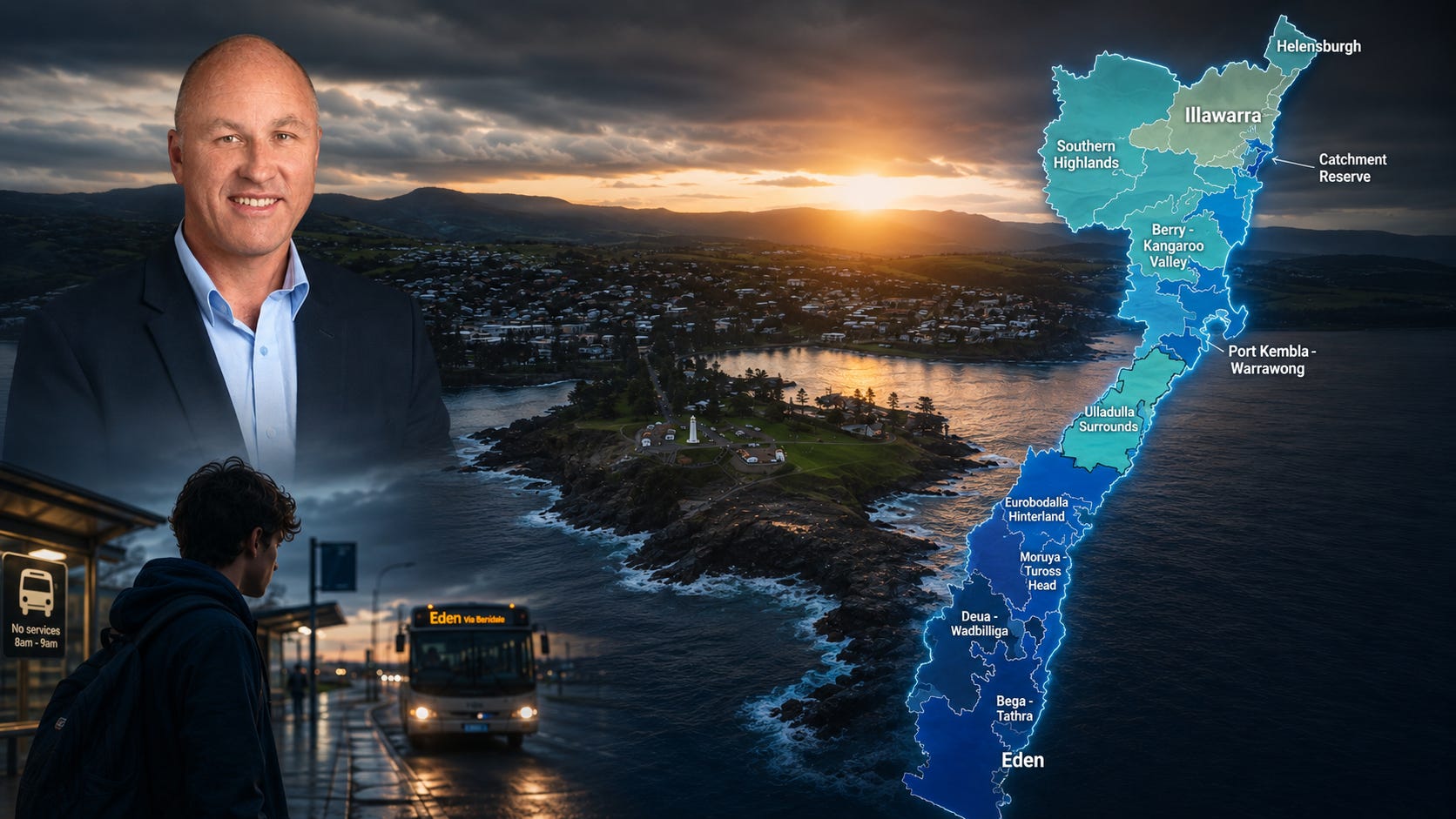
To higlight this, and push for action, The Pulse has developed an interactive tool that identifies where new transport links would make the greatest impact. By matching public transport accessiblity with areas of relative unemployment, the suburb-level data shows where investment in public transport would deliver the greatest benefit: matching job seekers with employers and improving access for the entire community.
The first to benefit will be young people.
According to the federal government’s Jobs and Skills Atlas, while the Illawarra has an unemployment rate of 4.7 per cent, roughly in line with the state and national average of 4.3 per cent, the youth unemployment rate, 11 per cent, is significantly above the state average, which sits at 9.6 per cent.
With young people in the region reliant on seasonal and insecure work, this rate can be volatile, with youth unemployment soaring to 12.7 per cent in January 2024, while nationwide the figures in that month dropped to 9.4 per cent.

While there are other regions in NSW and Australia with higher youth unemployment, for the Illawarra-Shoalhaven, what makes the statistic so stark is the number of jobs on offer, many of which are well-paid and long-term.
As displayed on RDA Illawarra-Shoalhaven’s State of the Workforce dashboard, in the latest month there were 1471 estimated vacancies in the Illawarra, with another 774 in the Southern Highlands and Shoalhaven.
Wales was well aware of the disconnect between the region’s job seekers and employers and had a sense that transport was the issue, but lacked the empirical data to back that up.
And although trials and pilots were underway, these were disconnected from one another, limiting insight into the most effective solution.
To tackle this, with colleagues in the Central West and the Capital region - the area of NSW surrounding the ACT - the local jobs hubs in each region joined together to investigate exactly how much of a barrier transport was to job seekers in their region.
Covering a swathe of regional NSW from the South Australian border to the Pacific Ocean, the disparities are stark, but what stands out in the Shoalhaven, in particular, is the correlation between low levels of public transport access and employment rates.
A hypothetical example cited in the report makes this clear. For a worker to travel from Bomaderry to South Nowra it would take between 10 and 20 minutes by car.
The same journey takes 47 minutes by public transport, with only one service suitable for a 9am arrival. An express bus did not operate during the morning travel period.
Until now, one of the initiatives offered by the NSW government is to make it easier for disadvantaged people in regional areas to obtain a driver’s licence, however, the study, authored by consultants Sparrowly Group, found driver’s licence attainment had little impact on employment prospects.
As Wales explains, what good is a licence if you can’t afford a car, or if a trip to the mechanic costs more than what you earn?
The same dynamics are also in play for access to the region’s education institutions, both for those living here, and those from further away, as noted by the draft Illawarra-Shoalhaven Integrated Transport Plan.
“There is high demand for University of Wollongong students from south-west Sydney to attend campus in Wollongong, and vice versa. However, there are limited and unsuitable public transport options and a lack of last-mile active transport infrastructure.”
There are also issues with accessing TAFE and vocational colleges.
“A lot of people may want to do a certain trade, but the local TAFE won’t offer it, so they need to try and find a way to get to TAFEs and training organisations that can deliver that,” Wales said.
This is also highlighted in the draft transport strategy, as “connectivity gaps for students and staff are a challenge to providing access to university and other tertiary destinations in the region”.
A TAFE NSW spokesperson acknowledged that travel can pose a barrier to education and said the training provider sought to ensure courses were available locally, whether through schools or online, but more convenient and affordable public transport “can make a real difference”.
To visualise these findings at the local level, The Pulse has developed an interactive map by aligning the NSW government’s Public Transport Accessibility Level database with unemployment figures from the federal Department of Employment and Workplace Relations. This pinpoints the locations where investment in public transport would deliver the greatest impact, down to the suburb.
Using the latest data from December 2025, a combined index ranks the areas that would benefit most from uplift in public transport accessibility. That is, the areas with the worst access to public transport and the highest unemployment rates.
Topping the list on the South Coast is Port Kembla and Warrawong, which has the greatest unemployment in the region and relatively worse public transport connections, particularly compared to the Wollongong CBD and the northern suburbs.
This is followed by Warilla and Berkeley and then Eden on the Far South Coast, which had the worst public transport score.
Even when zooming out statewide, the districts of Port Kembla, Warrawong and Eden stand out for their lack of public transport and high levels of unemployment, while the northern suburbs of Thirroul, Austinmer and Coalcliff are more similar to inner-urban Sydney.
The right solutions for the Illawarra-Shoalhaven will differ in each area. In the Port Kembla-Warrawong region, the draft regional transport strategy acknowledges particular challenges but also opportunities that will come with the BlueScope land transformation project and the TAFE proposed for the site, although stops short of committing to any particular mode of transport.
The Pulse understands TAFE NSW has been pushing for improved connections to current and future campuses in the region, as part of current masterplanning.
However, Wales said the community had been worn down by years of strategic plans with inconsistent follow-through, and wanted to see immidiate implementation on the ground. To this end, the Taskforce Wales chairs is taking steps to form an alliance of business owners in the Shoalhaven to provide local bus services connecting the outlying communities around Jervis Bay with employment regions in Nowra in the next 12 months, as well as utilising courtesy buses owned by RSLs and bowling clubs for on-demand transport.
“Our commitment is to get a trial happening in the Illawarra-Shoalhaven to demonstrate that.”
With the evidence base established, it was time to shift gears.
“We’ve done the research, we know what the issues are,” Wales said.
Now it’s time for action.
If you refer your friends to The Pulse Illawarra, and they subscribe, you will receive complimentary access to our content. Find out how it works here.
Future Proof
The Illawarra is poised for transformation. Smart money and forward-thinking leaders are positioning for opportunities ahead.
We’re proud to introduce a special guest series by Connor Pearce, a respected former business journalist at The Illawarra Mercury, who examines five game-changing dynamics and unpacks the big economic questions.
You can read more from the Future Proof series as Connor Pearce examines the future - and the fault lines - across key sectors that will define the Illawarra over the next decade:
As one - How a unified approach to defence industry is delivering for the Illawarra
What lies beneath - Tahmoor closure exposes gaps in government plan for a post-coal Illawarra
It’s AI-generated with a fake author - the rise of one of Wollongong’s most searched websites
Closing the loop: Inside the movement building a circular economy in the Illawarra
Not business as usual: The new wave of Illawarra businesses combining profit and purpose
A new energy: Meet the creatives reshaping industry in Port Kembla
Go south-west: Can Picton Road and the SWIRL precinct unlock new corridors of growth?
Port Kembla’s energy future: Will gas, hydrogen or offshore wind win out—and who will decide?
The new care economy: With aged care and the NDIS under pressure, what comes next?
Cranes in the sky: Housing policy from the ground up—and why not everyone agrees.
The business of play: Tourism’s next act, and how to price the “experience economy.”