


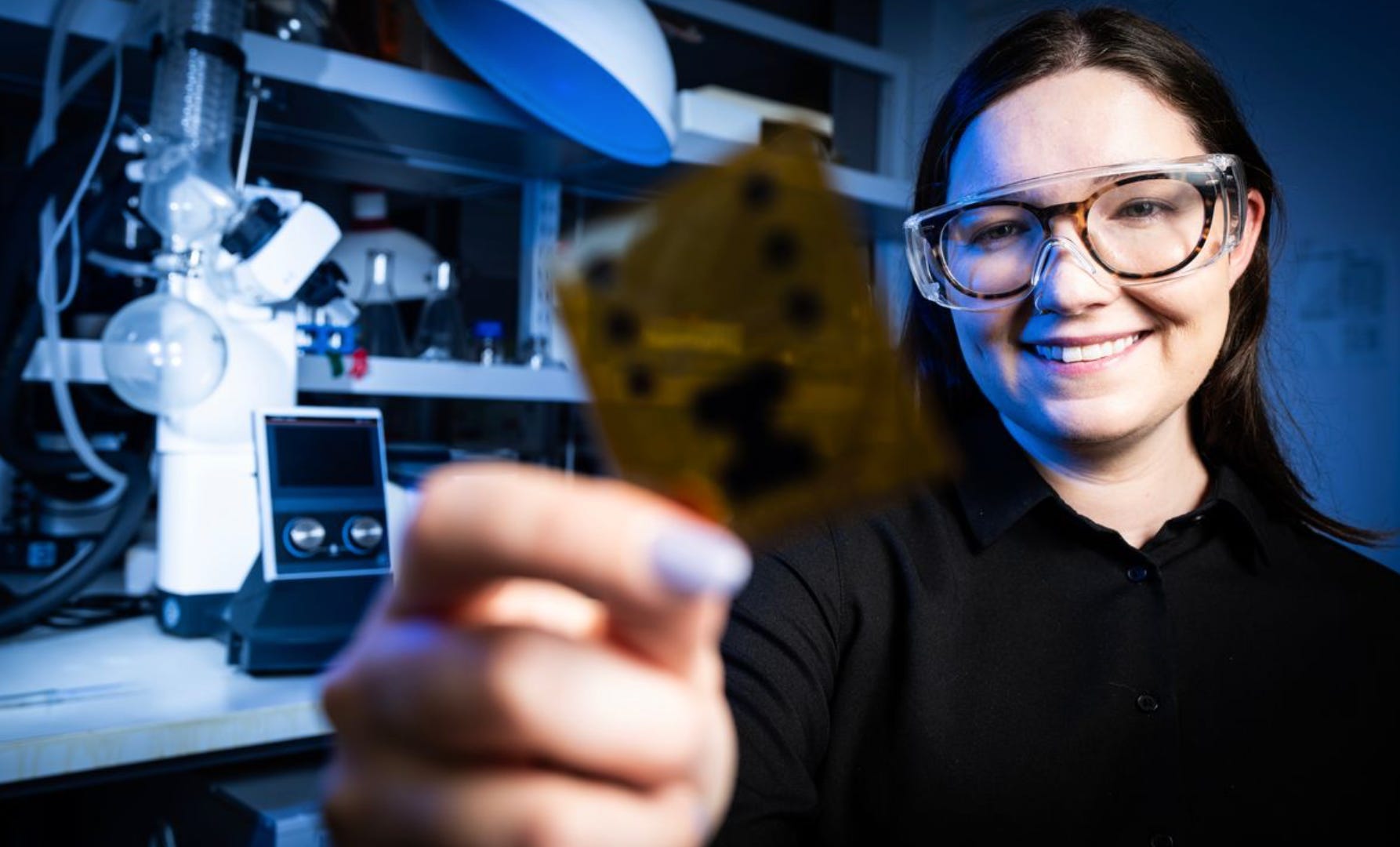
During National Science Week, while academics gathered at Science Space on Wollongong’s Innovation Campus to share their research, University of Wollongong Research Fellow Dr Jessie Posar was in her element.
Breaking down complex physics for non-experts is not a distraction, Dr Posar says, it is the entire purpose of scientific discovery.
“I’ve always made sure that anytime I talk to people, they can understand and be part of the conversation. Because at the end of the day, what are you really doing if your research doesn’t actually translate to people?”
At the core of Dr Posar’s work is what scientists describe as “flexible organic semiconductor sensors bridging fundamental physics with real-world economic potential”.
Did your eyes glaze over a little? What does that actually mean in everyday English?
Instead of heavy, rigid, and expensive silicon microchips, which are imported from overseas, Dr Posar works with carbon-based “liquid inks”. These inks can be printed onto flexible plastic, stickers, or textiles like stamps on a printing press. The result is a paper-thin, stretchable sensor capable of monitoring ionising radiation exposure in real time.
Four industries, one breakthrough technology
Dr Posar’s printable sensors have potential across four sectors:
Healthcare: Lab results show the sensors transmit 99.8 per cent of the radiation beam without disrupting treatment, and her team is exploring their use in microbeam radiation therapy for otherwise-untreatable brain cancers.
Nuclear & heavy industry: Sensors could be woven into clothing for wearable, real-time radiation monitoring in nuclear and industrial settings.
Space: Adapted from flexible solar-cell chemistry, the sensors could monitor cosmic radiation while harvesting energy to power spacecraft.
Defence & border security: An Office of National Intelligence-funded project is exploring low-cost radiation sensors to drive capability across our intelligence communities.
Sovereign capability
Supported by a National Intelligence Postdoctoral Grant, Dr Posar is investigating how Australia can manufacture these next-gen sensors locally rather than depending on global supply chains.
Because organic materials print like liquid ink, a local manufacturing pipeline would need a fraction of the upfront capital traditionally needed. What’s even better, is that Australia already possesses key pieces of this puzzle.
“The University of Newcastle has a roll-to-roll printing system that they use for solar cell applications,” Dr Posar said. “We have the facilities here in Australia. It’s just a matter of expanding that to all different applications, like monitoring ionising radiation.”
Combined with emerging automated platforms that can run 24/7 to formulate and test sensor prototypes, this technology could significantly accelerate the journey from laboratory discovery to commercial production.
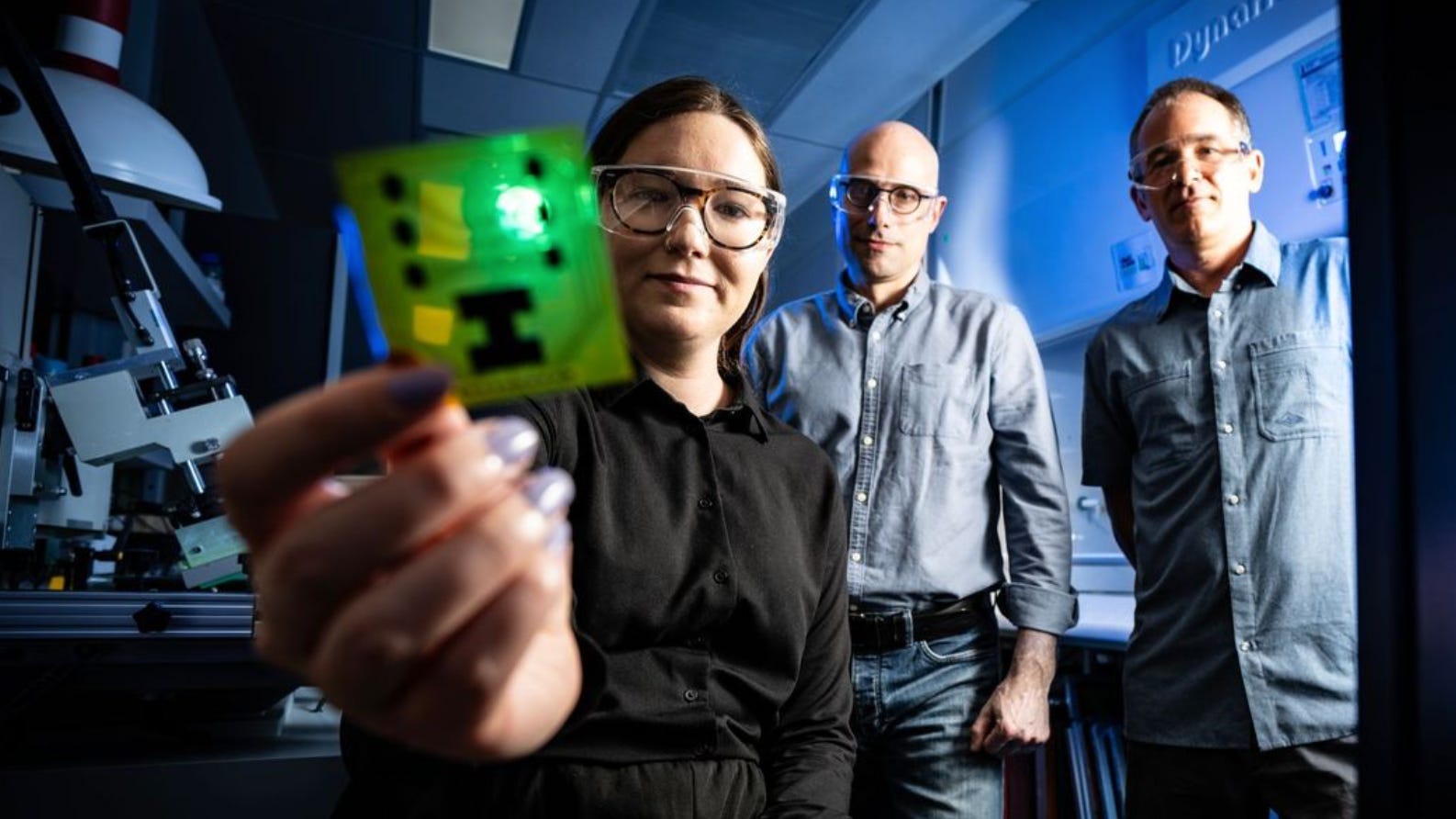
For Dr Posar, Science Week in August was an opportunity to connect this deep science directly to the region’s economic future.
“It was a time to think about and communicate the vision,” she said. “If we were able to translate this into industry, what would that industry look like, and how would the Illawarra benefit from that?”
Working across UOW’s main campus and Innovation Campus, alongside startup incubators like iAccelerate, Dr Posar is among a generation of Australian researchers who now design their projects around real-world impact.
“The way research happens is really changing in Australia,” Dr Posar said. “We’re not just doing interesting discoveries for the sake of discovery. The majority of research now is really pushing to: how could this be commercialised? What’s the impact it has on society?”
School outreach
For Dr Posar, the sensor breakthrough is only half the ambition. The other is making sure the Illawarra can sustain this kind of work into the future. That means helping researchers early in the unfamiliar territory of commercialisation, and reaching further back than the university gate.
“I do a lot of outreach into schools, like our local high schools,” she says, a habit she traces to the one teacher who noticed her own curiosity at the right moment. She now supervises PhD students of her own. It’s proof, she hopes, that a career in physics is less about being a genius than about staying curious, and that the next generation of Illawarra researchers don’t need to look far from home to find it.


