


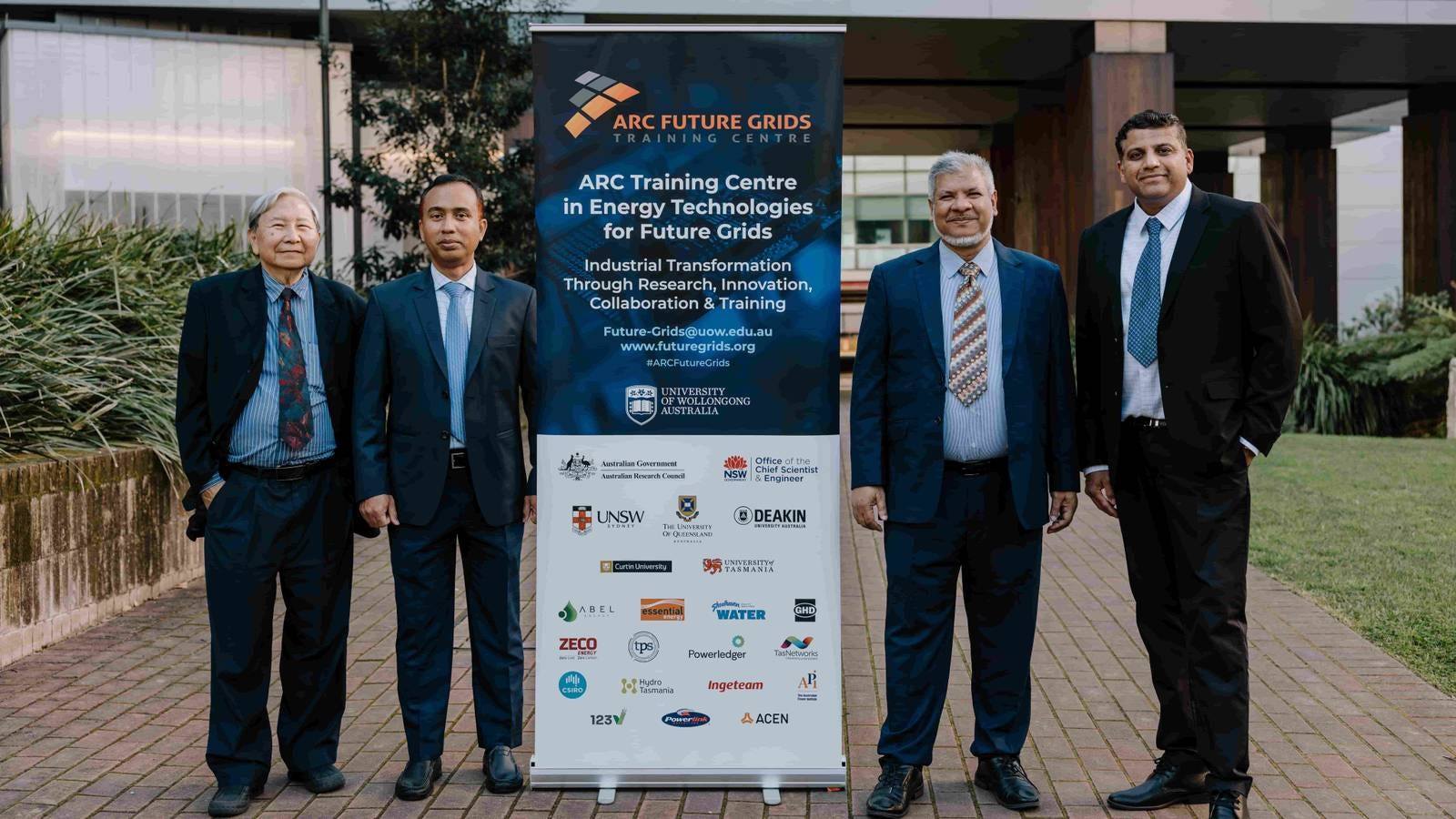
University of Wollongong researchers are targeting bottlenecks in Australia’s electricity grid that force renewable power to be switched off, with a new $1.55 million project exploring how existing infrastructure can carry more clean energy and potentially cut electricity costs.
The research team at UOW’s Australian Research Council Training Centre in Energy Technologies for Future Grids will provide the technical leadership on the project, developing technology to identify spare capacity in the network and redirect electricity around congested sections of the grid.
Distinguished Professor Kashem Muttaqi, Director of the UOW centre said around 1.5 terawatt-hours (TWh) of electricity was curtailed in 2025, according to the Generator Statistical Digest (GSD), published by WattClarity. Up from 1.2 TWh in 2023.
That means renewable generators can be forced to reduce their output because parts of the electricity network do not have enough capacity to carry the power being produced.
“We are wasting that power,” Professor Muttaqi said.
The project will investigate whether more of that electricity can be used by squeezing additional capacity from the infrastructure Australia already has, rather than relying solely on building new transmission and distribution infrastructure.
Professor Muttaqi said getting more renewable electricity through the network could ultimately benefit consumers.
“The power price we expect to reduce,” he said.
The problem researchers are tackling is similar to a traffic jam: one part of the electricity network can be congested while another nearby has spare capacity.
Professor Muttaqi likens the solution to a driver using GPS to find another route when the main road into Sydney is clogged.
“You try to avoid the traffic, and you find out another route nearby so that you can avoid it and you also can reach the destination,” he said.
The project aims to do much the same thing with electricity.
Smart devices known as Soft Open Points would allow power to be redirected from one part of the network to another, while sensors would continuously assess conditions and determine how much electricity individual lines can safely carry.
Together, the technologies could allow the grid to accept more renewable electricity without requiring equivalent investment in new transmission and distribution infrastructure.
“The main goal is to have more capacity released from the existing network, specifically for renewable energy hosting capacity,” Professor Muttaqi said.
“We can integrate more renewable into the network.”
The project, Unlocking the Latent Network Capacity via Soft Open Point and Dynamic Limit, is one of 14 projects funded through the Australian Government’s $30 million Grid Enhancing Technologies Grant Program.
UOW will lead network modelling, optimisation, digital twin development, laboratory validation and field testing, working alongside UNSW Sydney and industry partners BES Australia, Essential Energy, Ingeteam Australia and Sungrow Australia Group.
The technology is expected to move from the laboratory to a real electricity network from 2028.
Field trials are planned on Essential Energy’s network around Temora in south-west NSW, with the project expected to demonstrate its results by early 2029.
If successful, Professor Muttaqi hopes the technology can then be demonstrated in other parts of Australia before moving towards wider industry adoption.