


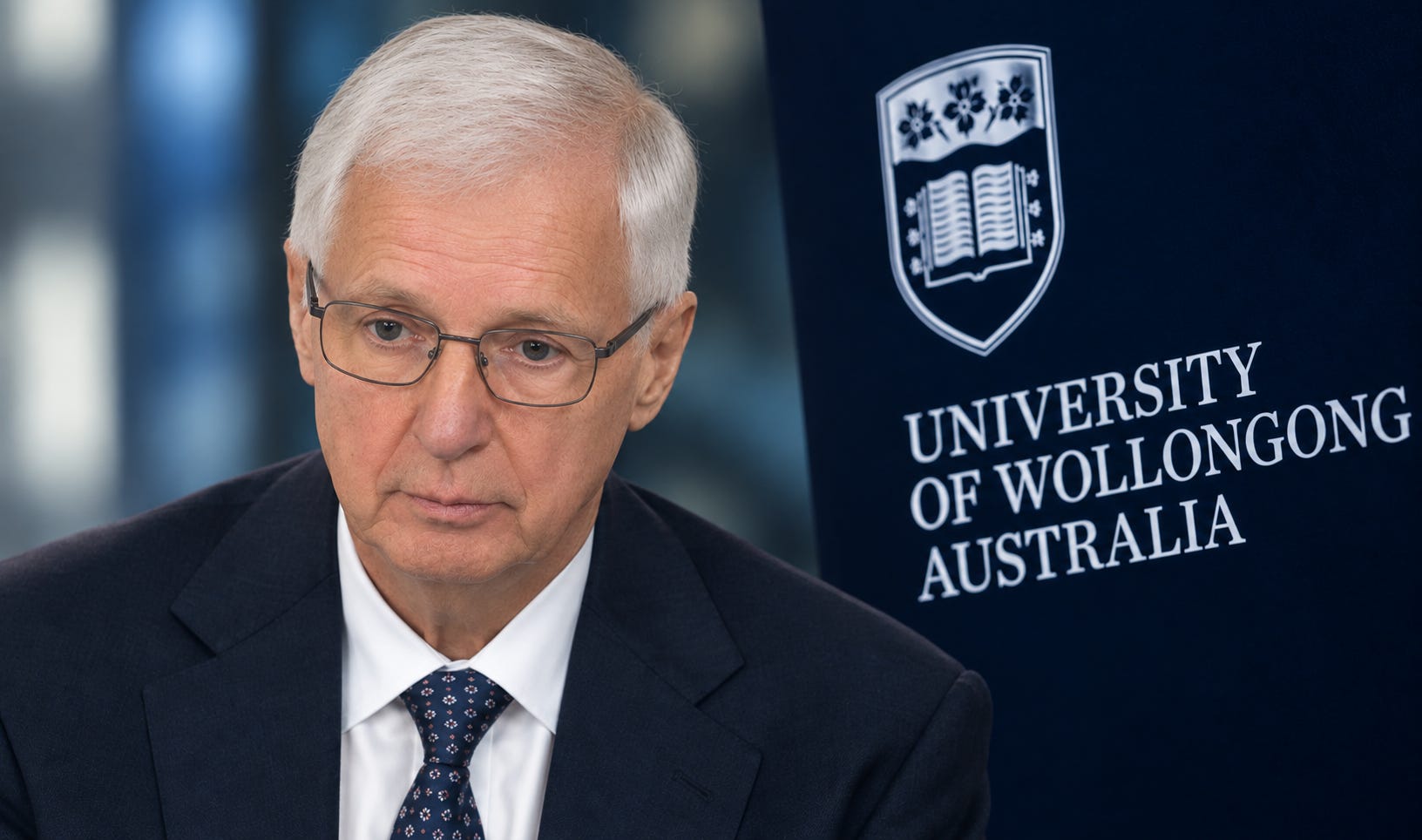
With one parliamentary inquiry’s findings now delivered and the Independent Commission Against Corruption’s still to come, the University of Wollongong is facing a pivotal moment: the appointment of its next chancellor.
UOW’s governing council is seeking a leader who can restore public confidence, but management and staff unions hold fundamentally different views on whether the university’s internal “governance reset” goes far enough.
With a union-organised public forum tonight (see box below) in the presence of inquiry chair Sarah Kaine MLC, it is understood a push for government intervention and the appointment of an administrator will be raised.
The appointment of a new chancellor comes after Michael Still resigned before giving evidence to ICAC in July. There has been months of scrutiny over a former interim Vice-Chancellor’s undisclosed consulting ties, ICAC’s Operation Scandi hearings into how staff and student representatives were sidelined from key decisions, and a sector-wide consultant spend that reached $139 million across NSW public universities in 2025 alone.
Reform hasn’t gone far enough: Unions
Local union leaders argue that despite executive promises of a culture shift, day-to-day decision-making is unchanged. Dr Susan Engel, UOW branch president for the National Tertiary Education Union (NTEU), said the NSW Upper House inquiry’s findings confirm what staff have argued for years: NSW universities require deep structural reform.
“UOW’s governance response so far is nowhere near the scale required,” Dr Engel said.
While Operation Scandi’s hearings exposed how elected staff and student representatives were pushed out of key decisions, the search committee currently selecting UOW’s new chancellor includes no elected staff or student representatives.
“That tells staff everything they need to know about whether lessons have been learned,” Dr Engel said, describing management’s approach to staff consultation as “tokenistic.” When staff are asked what qualities they want in their next chancellor, she said, the most common answer is simply “not corrupt.”
Other institutions, Dr Engel said, are moving toward greater elected representation on governing councils, a key recommendation of the parliamentary inquiry. She said UOW’s council has “lost the confidence of its own staff and community,” and argued the only credible path forward is for council members - other than elected staff and student representatives - to resign, making way for a new governing body to lead democratic reform.
The current selection process has attracted attention. Acting chancellor Greg West stepped into the role in June, when then-chancellor Michael Still stood aside for the duration of the ICAC hearings; Still resigned the day he was due to give evidence. West now also chairs the chancellor nominations panel tasked with selecting his own permanent replacement, meaning the person holding the role in an interim capacity is leading the process to fill it permanently, as The Pulse reported earlier this month.
Asked about the arrangement, a UOW spokesperson said the council “continues to discharge its governance responsibilities in accordance with the University of Wollongong Act 1989,” and that the process “will be conducted openly, with consultation across our community and stakeholders”.
The timeline compounds the concern. UOW’s own account, given to staff at an August forum, has the chancellor appointed in December - while the university’s promised external review of Council is scheduled only for “quarter one, early next year.” On that sequence, the body meant to assess whether council’s structures need to change will not report until after the new chancellor is already in place.
Vice-Chancellor Professor Max Lu has defended the university’s caution in discussing individuals named in ICAC evidence but not called as witnesses, telling staff there are “real legal limits” and obligations of “procedural fairness” constraining what UOW can say or do before the final report is published.
Reset predates the scandal: UOW
The university argues its reform program was underway before the ICAC inquiry began. A spokesperson said the “governance reset” project began after a late-2025 review of national governance principles and was formally endorsed by council in May 2026, “well preceding ICAC’s announcement of Operation Scandi”. ICAC publicly announced the investigation on June 2, 2026.
The spokesperson confirmed the review of Council itself “is not being run by UOW”, it will be an independent external review. UOW also pointed to structural changes already made to executive oversight, including separating the University Secretary function from governance, “with a direct reporting line to the council through the chancellor,” which it said was committed to “well ahead of the release of the final report.” Other measures underway include reviews of council appointment procedures, conflict-of-interest checks, a council skills matrix, and a member conduct charter.
The spokesperson noted the Upper House inquiry’s final report is now with the NSW Government, which has three months to respond. “Any decisions it makes on the recommendations of the report, UOW will act on as appropriate,” the spokesperson said, adding that UOW will also map ICAC’s findings against its renewal program, the same commitment it has made regarding the still-pending ICAC report.
In its interim report, the parliamentary committee recommended the Minister for Tertiary Education use powers under section 21D of the University of Wollongong Act 1989 to compel Council to report on its commercial operations, including UOW Global Enterprises.
A statewide reckoning
That followed the committee’s finding that former interim Vice-Chancellor John Dewar AO gave misleading evidence under oath about his financial ties to consulting firm KordaMentha, which secured UOW contracts worth $3.8 million.
The frustration isn’t confined to Wollongong. The NTEU NSW Division has welcomed the parliamentary report as a “generational opportunity” to reform higher education laws statewide. “The state’s university managements have collectively failed to protect the public good,” Vince Caughley, NTEU NSW Division Secretary, said.
NSW hasn’t reviewed its university legislation in 30 years. Caughley has urged the Minns Government to mandate 50 per cent elected staff and student representation on councils statewide.
PUBLIC FORUM: NSW University Governance Inquiry
Following the parliamentary inquiry’s 310-page final report, staff, students, and community members will gather to discuss its recommendations and a regional campaign for statutory reform.
When: Monday, September 28, at 5.30pm
Where: North Wollongong Hotel
Hosted by: NTEU NSW Division & UOW Branch
Speakers: Dr Sarah Kaine MLC (Legislative Council Standing Committee on Social Issues, chair); Dr Richard Denniss (The Australia Institute, Co-CEO); Arthur Rorris (South Coast Labour Council secretary); UOW NTEU representatives.
Open to staff, students and the public.