“We’re almost bust”: The question that secured $250k at NSW Cabinet’s Kiama forum
The full Q&A from the NSW Community Cabinet in Kiama.

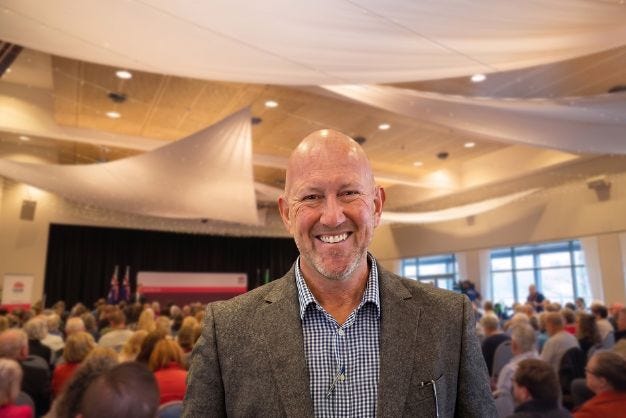
Mark Burns arrived at the NSW Community Cabinet forum in Kiama fearing he may soon have to shut down his men’s mental health charity, The Man Walk. He left with a $250,000 funding lifeline from Premier Chris Minns.
The founder of the organisation, which began in Kiama eight years ago and now operates across 101 locations, was handed the microphone at the Kiama Pavilion event with just five minutes to spare.
He revealed the organisation had just $8,000 left in the bank - enough to survive only another four weeks.
“We’re almost bust,” Burns said.
Burns told the Premier the organisation had experienced enormous growth but struggled to secure sustainable government or philanthropic funding despite supporting thousands of men every week.
“No one’s asked for money yet,” Burns joked during the session. “So I guess my question is - can we have some money to keep the charity going?”
The room laughed, but Minns responded immediately.
“The answer is yes,” the Premier said, drawing cheers from the packed hall.
“That’s a very reasonable request for an important community organisation.”
The Premier said the government would work with The Man Walk on a longer-term funding arrangement, but described the prospect of the organisation collapsing before then as “unacceptable”.
Afterwards, Burns said he’d already started considering the process of winding up a charity.
“I can’t quite believe it’s happening,” he said.
“We can do what we truly want to do and help bring in more support, give our education programs, support existing walks and start new ones.”
There were other wins during the cabinet event, where Minister for Health, Ryan Park, said plans were underway to address the use of plastic in local hospitals, and Penny Sharpe committed to reviewing the recommendations of the Food production and supply in NSW report, as requested by a University of Wollongong researcher.
While some questions were answered, but unanswered, if you know what we mean.
You can read an edited version of the dialogue below.
Overdevelopment in Kiama
Question from Gail Morgan:
Why are we allowing overdevelopment in a heritage town like Kiama when affordable housing could be built elsewhere?
Answer from Premier Chris Minns:
I can tell that there’s certainly community concern about that, and it is a beautiful town. There’s no doubt about it. I can understand that you’re protective of it and want to make sure that if there are changes, it doesn’t change the unique nature of it. I do respect that.
I also acknowledge that we need to ensure that when we’re developing planning instruments or making planning changes, they’re different for each community. We’re Our track record has been largely agnostic about new homes and where they go in. But they have to go in somewhere. And I did have a good meeting with the Mayor of Kiama about opening up new housing developments to the north.
I think we need a solution there, which could benefit everybody. New homes that we desperately need, whilst taking the pressure off the city, CBD, and the surrounding areas, which are obviously of concern to you and the local residents.
When you’ve got an aging population, you must have houses for the next generation.
We are prepared to do a deal with the local council to get more supply. If the local community comes to us with a reasonable plan, our history shows we’ll accept it.
My strong view is that we can have reasonable development, places for young people to live and work in their local community without destroying character, and it’s called density done well. So, work with us, and we will get a good outcome. I’m convinced by that, particularly after speaking with the mayor earlier today.
Affordable Housing and High-End Development
Question:
South Kiama Drive has around 400 approved lots, and Jamberoo has around 1,000 approved. That’s where affordable housing should go. What’s being proposed here in town are luxury apartments worth millions of dollars. Local families won’t be able to afford them.
We’re losing car parks and town space for developments that won’t help ordinary residents. Why do you support developments like the Akuna Street proposal?
Answer from Premier Chris Minns:
I don’t know about the specifics of the Akuna Street development, but maybe I can get the details from you after the meeting. When it comes to new developments, we are pushing affordable, social, and other types of new housing as well.
It’s not just the case that we’re proposing social and affordable housing only. We are after new developments, private dwellings in other parts of the economy, and there’s a reason for that. If there is an apartment that, for example, a downsizer wants to move in closer to the sea or the city CBD because there are more services.
It does provide the opportunity for a family home, for a young family to move in, and hopefully that family’s moving from a rental accommodation that someone else can move into … We’ve seen in the past where there’s been an exclusive concentration on public or social housing and no private development at all, that you don’t get the kind of diversity within a society and a community that you need to make it work.
Land Acquisition for Highway Upgrades
Question:
The government is acquiring more land than necessary for the Princes Highway upgrade. In our case, you’re taking about 2,000 square metres when only a fraction appears necessary. The service road will end up 10 metres from my son’s bedroom instead of over 100 metres away.
We’re also only getting 14 days to review a 1,000-page environmental document and submit feedback.
Why isn’t Transport being more transparent?
Answer from Premier Chris Minns:
Every single time we pursue a major project, a road-building project, a hospital project, or even school projects, there is an obvious tension there.
If we put in new roads, in some instances, we cannot build the road or the ramps without taking private land. It’s really deeply regrettable. We don’t like doing it, but the the cost of not doing it is progress, and I’m faced with the dilemma because we need to build infrastructure in this community.
Parkinson’s Specialist Nurses
Question from Lesley Errington from Parkinson Support Kiama.
Will there be funding for a PD specialist nurses in country regions in the next budget? Parkinson specialist nurses will save you heaps of money in our public hospitals. All I want you to tell us is, can you assure us you are seriously looking into this issue?
Answer from Ryan Park, Minister for Health
What a terrific question, but more importantly, one incredible organisation. The Treasurer is here, so I can’t let anything out on the budget otherwise, we’re all in trouble, but let me assure you we are looking at that very, very closely. We understand the role they play.
We also understand the impact that Parkinson’s is having across the community and we also from my perspective understand that if we do that investment early, it can make a big difference to the health outcomes only for the individual, but I’ve got to be honest with you, with the family and carers who are supporting that person, and that’s as equally as important for me as the Health Minister.
Youth Crime Prevention
Question from Scout and Emily from Propel Project Dharawal
What is the NSW Government doing to support early intervention for young people to prevent youth crime and incarceration?
Answer from Minister for Youth Justice, Jihad Dib:
Our biggest intention is to make sure that we stop the unemployment from being incarcerated, and we’re stopping people from going down a life of crime. The big focus has been specifically on diversion programs.
We do a lot of work across government, including working with the police minister, our regional affairs minister, and of course, health and education. If we talk about specific programs, just recently we’ve been able to get some funding from the Treasurer, looking at innovative ways that we can stop young people from going down a path that is destructive for them and for the community.
And that’s about making sure that we engage with people early, working with community groups, and getting the young person to go down a better trajectory of life. It’s about working with local communities, looking at the root cause of it and some of that really exciting work in making investments into diversification.
South Coast Rail Line
Question from Pat David, Unions Shoalhaven
When will we get a firm commitment to upgrading and electrifying the South Coast rail line?
Answer from Premier Chris Minns:
I think there’s been a decade-long underinvestment in the heavy rail system across New South Wales, at the expense of new metros. And metros are great, and they’re really important, and they’re fantastic if you live in Sydney. The vast majority of people use the heavy rail infrastructure.
Because of a lack of investment, we’ve seen replacement trains and delayed services as well as outages on the system way more than we’ve had in the past.
So, the Minister for Transport put hundreds of millions of dollars into an emergency package to repair the heavy rail network where it’s failed, the signals, the systems, but we’re looking very closely at our election commitments as it relates to South Coast public transport infrastructure, and it’s got to be centred on the rail line.
If we’re going to do these things, we need a better share of national infrastructure dollars. They’ve got deeper pockets than the New South Wales government, and I don’t think it’s right that our dollars are subsidising other States’ spending and infrastructure because we’ve got needs right here in New South Wales as well.
Food Security and Food Waste
Question from Susie, University of Wollongong researcher:
Will the NSW Government respond to the 2023 inquiry into food supply in NSW? The report highlighted vulnerabilities in the food system and opportunities to strengthen local food resilience.
Minister for the Environment, Penny Sharpe
I haven’t read the report. But I actually have some good news in this space.
We currently have a whole range of programs, and we’re funding more organisations than we ever have before to do that local requirement to actually track the food that’s being thrown out by hospitals, by supermarkets, and actually funding all of those fantastic organisations that I’m sure you’re really familiar with.
That doesn’t respond to all of the 33 recommendations … we’d have to get back to you on the rest of the 33, but there’s actually been a big change, and it’s partly as a result of that report.
Indigenous Housing Funding
Question from Aunty Gwenda Jarrett
Where is the funding going for Indigenous housing in our region?
Answer from Treasurer Daniel Mookhey:
We do look to partner as closely as we can with Aboriginal communities across the state… I’m very happy to learn more about it and to understand what we can do.
Electric Vehicle Charging Infrastructure
Resident and Business Owner:
I started a local transport business using an electric vehicle, but there are no fast chargers in the Kiama area. I have to leave the LGA to recharge, which affects my ability to provide transport services.
Will the government fund fast chargers locally?
Answer from Premier Chris Minns:
We’ve put $250 million into charging stations across the state, but we needed to do more, and there is opportunities to work with electricity providers, the distributors about ensuring we see more charging stations, particularly in regional New South Wales because the truth is we’re going to see more and more more people purchasing electric vehicles and it will become a bigger part of the industry in the state, primarily because we’re seeing such dramatic rises in petrol and diesel prices as a result of the Middle East.
The new Shellharbour Hospital
Angela Pridham, life member of the Nurses and Midwives Association Representative:
My question is about the New Shellharbour Hospital.
I’m not sure how you’re going to get all the extra nurses because the capacity of the new hospital is an extra 30%.
Answer from Premier Chris Minns:
We believe that with ratios negotiated with the unions, the 16% pay rise over the 3-year period and the recruitment of the COVID nurses, that we are making big inroads in both retaining experienced versus on our wards to help people in difficult circumstances when they need it, but also attracting and recruiting people that might have gone to the private sector or another jurisdiction.
Angela Pridham, life member of the Nurses and Midwives Association Representative:
I was wondering whether whilst you’re still in the building stages of Shellharbour Hospital, whether you could think about doing something to reduce the plastic because currently, patients get a bottle of water at every meal and that plastic bottle goes into landfill.
Answer from Minister for Health, Ryan Park
We are trying across the board both from an environmental perspective and a funding perspective. Hunter New England started this program very early, but I know Margo and the team here (Illawarra Shoalhaven Local Health District) are working on a range of initiatives to do that.