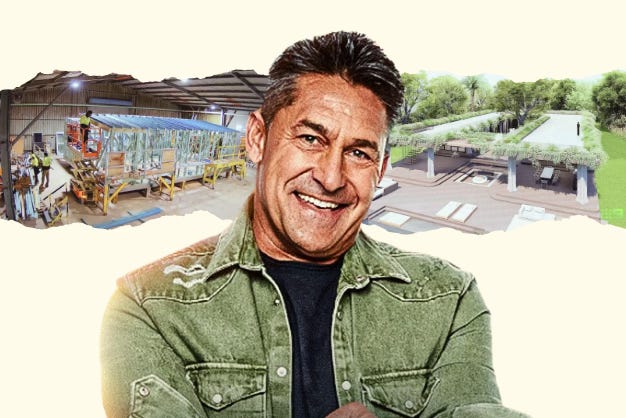
Why Jamie Durie belongs in the housing crisis debate, not just on TV
Multi-faceted landscaper-designer-builder to speak at housing summit

When the speaker list for next month’s Future of Housing Summit was released, one name stood out. Jamie Durie. Why is a former television gardener addressing one of Australia’s most acute policy challenges in Wollongong?
The answer lies in a career trajectory that’s shifted from ornamental landscaping to applied construction technology.
Over the past decade, Durie has moved into hands-on residential building, using his own developments as test cases for faster, lower-waste construction. Most recently, he has been building Australia’s second 3D-printed concrete home as part of his series Jamie Durie’s Future House. The method removes traditional formwork, reduces material waste and significantly shortens construction time.
The project is framed not as a novelty, but as a response to two pressures shaping the housing market: constrained supply and a chronic shortage of skilled trades. These are issues that resonate sharply in the Illawarra.
“This isn’t about luxury anymore,” Durie said of the build which is being evaluated by the Green Building Council of Australia. “It’s about methods that are affordable, resilient and fast to build.”

While the high-end 3D-printed prototype was constructed on his family’s country property in northern NSW, the broader program has extended beyond showcase housing. A prefabricated concrete home was delivered for a Canberra family, and twin modular houses were built on a single block in the Blue Mountains to accommodate separated parents. The emphasis, Durie argues, is on replicable models that can reduce build times and labour intensity.
Across these projects, Durie has incorporated technologies that remain uncommon in mainstream Australian housing. Completed builds have used geothermal heating and cooling systems, lower-carbon concrete mixes, and “healthy home” specifications such as low- and zero-volatile organic compound (VOC) materials. These are not conceptual designs, but occupied or near-complete homes that have been publicly documented and assessed against industry benchmarks.
Several of the projects have been independently audited by the Green Building Council of Australia, placing them within the same assessment framework applied to large-scale residential and commercial developments. For a summit focused on policy and delivery, such scrutiny adds weight to Durie’s inclusion.
Earlier, he tested many of these ideas at the upper end of the market at Belah House, a Northern Beaches residence he described as “the Ferrari of eco-building”. The home runs on a 20-kilowatt solar system with 42 panels, uses seven geothermal probes sunk 120 metres into the ground for heating and cooling, and incorporates concrete engineered to cut carbon emissions by around 45 per cent. It achieved an 8.2 energy star rating using low-VOC paints and zero-VOC adhesives.
These materials, Durie argues, are essential for reducing respiratory health risks: “We have data showing that five medium-sized plants in a room can reduce volatile organic compounds by 75 per cent.”
The combination of experimentation and verification underpins Durie’s place in the housing debate. Rather than commenting from the sidelines, he is attempting to demonstrate how emerging construction methods and environmental standards might be deployed at scale, and where they collide with planning systems, cost constraints and workforce realities.
Durie will speak alongside Wollongong MP Paul Scully, the NSW Minister for Planning and Public Spaces, and Rose Jackson, the Minister for Housing and Homelessness, at the City Beach Function Centre on February 20. Tickets here
If you refer your friends to The Pulse Illawarra, and they subscribe, you will receive complimentary access to our content. Find out how it works here.