


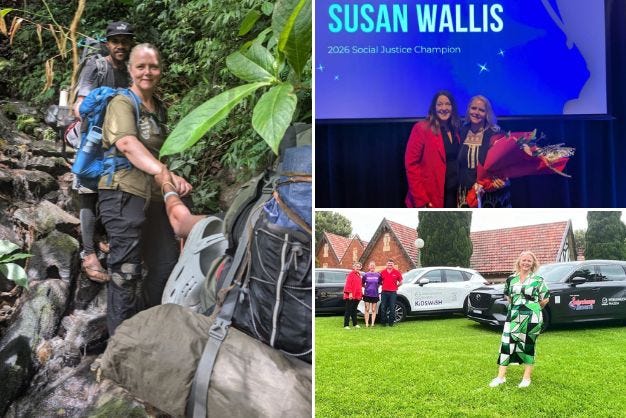
A “can-do, never-say-die attitude” and years spent turning ideas into action have earned Susan Wallis Community Industry Group’s 2026 Social Justice Champion award.
Wallis was recognised for almost two decades with Interchange Illawarra, her fundraising efforts and her ability to forge partnerships between the corporate and not-for-profit sectors.
Much of that work has been shaped by daughter Gracie, who had cerebral palsy and became a familiar face in the campaign for the National Disability Insurance Scheme before her death in 2018, a week after her 13th birthday.
Wallis and her family went on to establish the Gracie Wallis Scholarship, awarded annually to support a young woman with disability to pursue her ambitions.
Her broader community contribution has included raising funds through the Kokoda Track and the Great Illawarra Walk, as well as almost 19 years on the governance team at Interchange Illawarra.
Accepting the award from Member for Cunningham, Alison Byrnes and Member for Whitlam, Carol Berry, at Community Industry Group’s Social Justice Luncheon on Tuesday, Wallis reflected on what volunteering had given back to her.
“Volunteering has been … a protective factor for me. It’s the greatest honour,” she said.
“I get more out of Interchange Illawarra than I have ever given.”
Wallis thanked the judges and paid tribute to the other finalists, describing them as “incredible people doing great things”.
She also acknowledged her husband Mark and daughter Sophie, saying Mark had given her “the two best gifts in the world” in Gracie and Sophie.
Wallis was selected from six finalists, alongside Cram Foundation chair Bill Dowson OAM, UNSW Honorary Professor of Health Services Research Kathy Eagar AM, former Disability Trust CEO Margaret Bowen, SASSI CEO Penny Dordoy, and not-for-profit advocate Sharon Callaghan.
Community Industry Group chief executive Nicky Sloan told the luncheon that the finalists represented the practical action needed at a time when social justice was under increasing pressure.
She pointed to housing and cost-of-living pressures, financial stress and loneliness among older people, while community organisations were being stretched by growing demand and finite resources.
“For many people, the promise of a fair go is just a little bit more fragile than it used to,” Sloan said.
Sloan also warned of increasing division in public debate and the tendency to blame particular groups for economic hardship and social change.
“Social justice, I think, is the foundation of any healthy society,” she said.
“The belief that every person has inherent worth, that every person deserves dignity, that every person should have the opportunity to participate, to contribute, and to thrive.”
But she said the six finalists demonstrated what could happen when people chose to respond to those challenges through action.
“They’ve chosen to get involved. They’ve chosen to stand alongside others, and they’ve chosen to make a difference, and that matters,” Sloan said.
“Hope isn’t simply a feeling. Hope is a practice. Hope is something we do.”
ABC national disability affairs reporter Nas Campanella was a guest speaker at the annual luncheon, which brought together community service providers, advocates and sector leaders from across the region.


