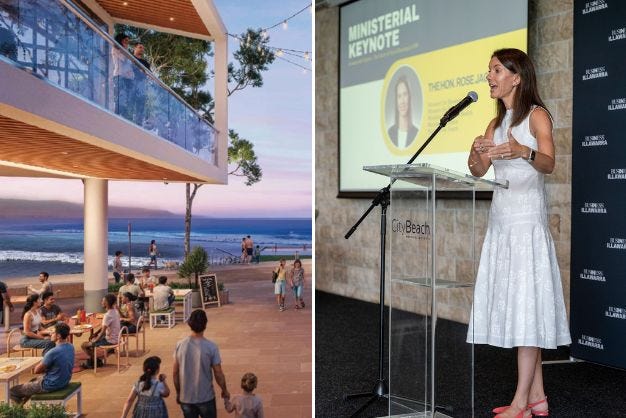
Could Bellambi be the suburb that changes how NSW builds homes?
Minister for Housing Rose Jackson outlines her vision.
The proposed renewal of the Bellambi housing estate is being held up by both government and industry as a project that could shape housing delivery across New South Wales.
Speaking at the Future of Housing Summit hosted by Business Illawarra at City Beach Function Centre on Friday, February 20, Housing Minister Rose Jackson said the state is moving away from concentrated public housing estates toward integrated communities combining social, affordable and private housing.
“I don’t want us to be the ugliest building in the street anymore,” Jackson said.
“I want it to seamlessly blend in with private market housing and affordable housing in a tenure-blind way.”
Ms Jackson said the change reflects shifting demand, with most applicants now singles or small households rather than families, and a broader recognition that housing plays an economic role.
“I don’t want us to see social housing as charity. I want us to see it as vital economic infrastructure.”
Jackson said integrated redevelopment is central to future policy nodding to the Bellambi proposal.
“Those mixed estates are so much more functional if the social housing sits alongside affordable housing and it sits alongside market housing,” she said.
Homes NSW’s Bellambi renewal, which could deliver around 2,500 homes to replace ageing social housing, reflects that approach.
The Bellambi Rezoning Proprosal is out for public consultation, reduces lot sizes to 200sqm and has a 30 per cent social housing requirement.
Private sector partners say estate renewal projects now aim to reshape how suburbs function, not simply replace homes.
Charles Daoud, Director of Traders in Purple, which partnered with Homes NSW and the Housing Trust on a mixed-tenure development on Crown Street, Wollongong, said modern redevelopment considers how neighbourhoods connect to surrounding areas.
“We’re not just renewing social housing … there is an understanding that the area itself is a destination.”
He said design outcomes depend more on early planning than expensive architecture.
“You can have a good design without being expensive.”
Referring to Bellambi, Daoud said the proposal links housing with existing amenities.
“People from outside Bellambi are going to be visiting. They’ve structured the master plan in such a way that it encourages visitation. That can only be a wonderful thing when you are starting to talk about things like mixed housing.”
The minister acknowledged social housing cannot be delivered without public subsidy, but said private participation is essential to scale delivery.
“Governments have to put money on the line to subsidise delivery of social housing, or it’s not going to happen.”
Housing Trust CEO Amanda Winks reinforced the social purpose behind the model.
“We are talking about types of rents. We are not talking about types of human beings. We are all equal, and we all have the equal rights to a home.”
She also said affordable housing investment was “stable and reliable”.
“We have got very low rates of arrears, very low rates of turnover… on average our tenants spend with us almost 10 years,” she said.
Daoud said investor interest is growing but depends on certainty.
“The worst thing that we can possibly do is play around and destabilise what’s been created.”
Jackson said integrated housing benefits the wider community, not just tenants.
“Even if you never live in social housing … you benefit from having a society in which people are able at different income levels to access stable housing.”
You can also read about the big questions industry put to government at the Future of Housing Summit here.